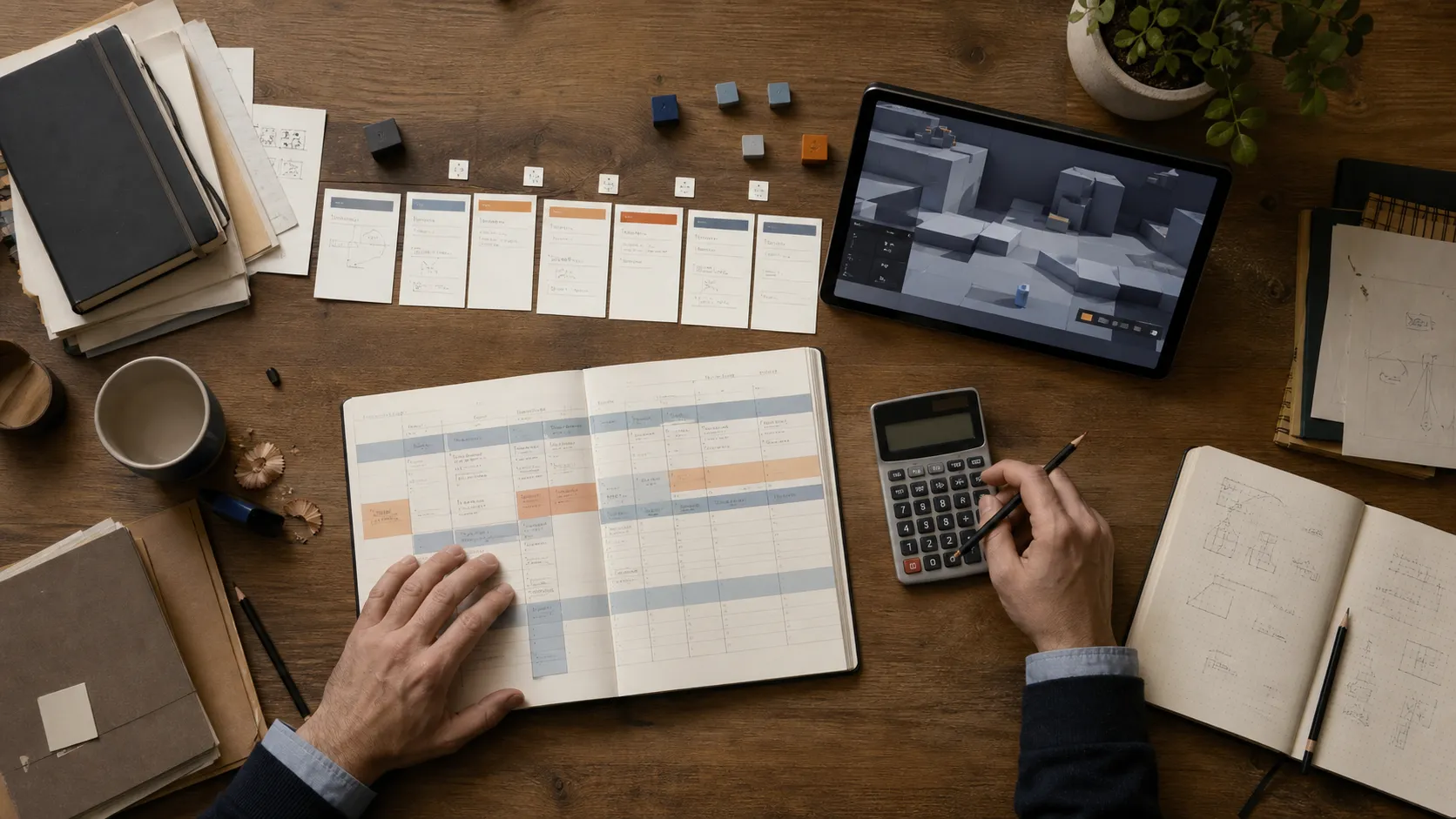
A game development budget template is a living forecast that connects scope, team capacity, external spend, technology, release work, contingency, and approval decisions. It should preserve the original baseline while showing actual cost, current forecast, variance, confidence, and the assumption behind every material line.
The template below is designed for founders, publishers, and producers who need to fund a playable milestone or full production without pretending that every unknown is settled. It can be copied into a spreadsheet, project database, or financial planning tool. The structure matters more than the software.
Start with the editable file.Use the CSV as a clean working base, then adapt the categories, periods and approval rules to your production.Download the game development budget template (CSV)
Game development budget template control panel
Put the decisions at the top of the document. A stakeholder should be able to understand what is funded, what is not, and where confidence is weak before reading individual cost lines.
| Field | What to enter |
|---|---|
| Budget version | A unique version and approval date |
| Funded outcome | The playable milestone or release state this budget supports |
| Scope baseline | Link to the approved scope and exclusions |
| Target platforms | Named devices, stores, and platform assumptions |
| Budget owner | Person accountable for the forecast |
| Approval authority | Person or group able to release or reallocate funds |
| Current forecast | Actual cost to date plus forecast cost to complete |
| Confidence | High, medium, or low, with a short reason |
| Next decision gate | Date, evidence, and decision options |
| Top budget risks | Named uncertainties with owners and response plans |
Use a one-sentence funded outcome. “Build the game” is not specific enough. “Produce a representative playable slice on the target PC configuration, with the core loop, benchmark environment, packaged build, and revised production forecast accepted” gives the budget a boundary.
Copy the core game development budget template
Create one row for each meaningful work package or cost commitment. Do not combine unrelated work into a large “development” line. Add enough detail to show which assumption or decision caused variance.
The game development budget template should stay readable enough for a producer to maintain. Add detail when it improves a decision, not simply because the spreadsheet permits another row.
| ID | Category | Work package | Owner | Basis | Baseline | Actual | Forecast to complete | Forecast total | Variance | Confidence | Assumption or note |
|---|---|---|---|---|---|---|---|---|---|---|---|
| EX-01 | Example: engineering | Example: representative combat feature | Named owner | Team capacity by period | Approved amount | Recorded cost | Current estimate | Actual + forecast | Forecast – baseline | Medium | Depends on approved input and tuning access |
| EX-02 | Example: art | Example: benchmark environment | Named owner | Asset plan or vendor quote | Approved amount | Recorded cost | Current estimate | Actual + forecast | Forecast – baseline | Low | Pipeline has not yet produced a representative unit |
Replace the example rows rather than adding your forecast beneath them. Give every line a basis. A basis can be internal capacity, a vendor statement of work, a current license term, a hardware quote, or a unit estimate derived from a representative asset. “Producer estimate” is acceptable only when the supporting assumptions are recorded.
Use consistent budget formulas
Keep the arithmetic simple and inspectable:
- Forecast total = actual cost to date + forecast cost to complete.
- Variance = forecast total – approved baseline.
- Available budget = approved budget – committed cost – actual uncommitted spend.
- Milestone exposure = unpaid commitments + remaining internal labor + unresolved external costs.
Decide how internal labor is valued and apply the same method throughout the project. Financial reporting may treat payroll differently from project planning, but the production model still needs to show finite team capacity. A “free” internal month can be the main reason another milestone is delayed.
Keep tax, currency, payment timing, and accounting treatment in dedicated columns if they matter to cash planning. Do not mix those rules into production quantities where they become hard to audit.
Organize the budget into production categories
Use categories that match how the game is made and reviewed. The list below is a starting structure, not a requirement to fund every line.
Product, design, and production
- Product direction and stakeholder decisions
- Game design, systems design, narrative, and economy work
- Production planning, coordination, and reporting
- User research, playtesting, and prototype facilitation
Engineering and technical operations
- Gameplay, systems, tools, UI, online, and platform engineering
- Build infrastructure, source control, deployment, and diagnostics
- Backend services, telemetry, security, and data operations
- Technical discovery, profiling, optimization, and maintenance
Art, animation, and audio
- Concept, UI, characters, environments, props, VFX, and lighting
- Rigging, animation, cinematics, and technical art
- Music, sound design, voice, implementation, and licensing
- Source cleanup, asset validation, and in-engine integration
Quality, localization, and release
- Test strategy, functional QA, compatibility, performance, and regression
- Localization, linguistic testing, accessibility, and ratings
- Platform accounts, hardware, packaging, submission, and store materials
- Launch operations, support, incident response, patches, and updates
External and business costs
- Game development outsourcing and specialist vendors
- Legal review, intellectual property, privacy, insurance, and compliance
- Engine, middleware, software, cloud, and service terms
- Marketing production, community operations, and distribution support
Separate production cost from user acquisition or broader company overhead when different people approve them. Keep a linked summary so the full cash requirement remains visible.
Add an assumptions register
The assumptions register is the most important companion to the numbers. A budget line is only as credible as the condition behind it.
| Assumption | Status | Owner | Evidence needed | Decision date | Budget effect if false |
|---|---|---|---|---|---|
| Example: target scene meets performance budget without a content redesign | Open | Technical lead | Profiled packaged build on target hardware | Named gate | Re-estimate optimization and content work |
| Example: internal team can review each external delivery window | Unconfirmed | Producer | Allocated reviewer capacity | Before onboarding | Move schedule or fund review support |
Use confirmed, assumed, open, or invalid as status labels. When an assumption becomes invalid, update the affected forecast rows and record the decision. Never overwrite the old baseline.
Build contingency around risks, not percentages
A blanket contingency may be useful for an executive summary, but the working budget should explain what the reserve protects. Create a risk register with trigger, potential effect, mitigation, owner, reserved response capacity, and authority to use it.
Typical game production risks include an unproven core system, a performance target without representative content, missing source access, unknown platform condition, uncertain content throughput, third-party approval, or an external team that has not completed onboarding.
Release contingency only through the agreed decision process. If a risk closes without consuming its reserve, decide whether the capacity returns to the overall budget or protects another named risk. It should not silently fund new features.
Connect the budget to milestones
Funding should follow evidence. Link every major cost line to a phase or decision gate in the game development timeline. A prototype budget should close a focused uncertainty. A vertical-slice budget should create representative production evidence. A production budget should scale accepted patterns.
Add a milestone summary table:
| Milestone | Acceptance evidence | Baseline | Current forecast | Confidence | Funds released | Next authority |
|---|---|---|---|---|---|---|
| Named milestone | Playable or verifiable result | Approved amount | Actual + forecast | High, medium, or low | Approved commitment | Named decision maker |
This view helps investors and publishers see exposure without reviewing every production row. It also keeps the budget tied to the development process rather than to reporting periods alone.
Model external development correctly
For every vendor or co-development partner, include discovery, onboarding, delivery, client-side review, integration, change, and hand-off. A quote may cover only part of that chain. Add the internal producer and lead time needed to make the engagement work.
Keep these fields beside each external commitment:
- Statement of work and version
- Commercial model and payment trigger
- Included roles and allocation
- Client inputs and reviewer capacity
- Acceptance criteria and evidence
- Change-control method
- Source, provenance, documentation, and support obligations
Use the partner due-diligence questions before treating a proposal as a comparable budget input. Different scopes, ownership models, and exclusions should not be ranked by total alone.
Verify technology and platform costs at the source
Engine, store, platform, and service terms can change. Do not copy an old fee or license assumption from another project. Link each material cost to the current official documentation, note the date checked, and state what usage level, product revenue condition, seat count, or distribution route the assumption covers.
Apply the same discipline to cloud services and middleware. Model both development usage and post-launch operation where applicable. A free development tier may not represent live demand, while an enterprise contract may include capabilities the project does not need.
Run a monthly budget review
A budget review should produce decisions, not only variance commentary. Use this agenda:
- Confirm actual cost and committed spend.
- Update forecast to complete from current production evidence.
- Explain material variance by scope, assumption, rate, capacity, or dependency.
- Review contingency triggers and reserve use.
- Check cash timing against invoices, payroll, and milestone approvals.
- Record decisions, owners, and changes to the baseline or forecast.
Keep the game development budget template synchronized with the approved scope and schedule after the meeting. A decision recorded in minutes but missing from the forecast will be rediscovered as variance.
Review high-uncertainty lines more often at the production level. The financial summary can remain monthly while producers update forecast confidence after each meaningful build, benchmark, or platform test.
Final checks before approving the budget
- The funded outcome and exclusions are understandable without the full design document.
- Internal labor and review capacity are visible.
- Content volume is based on representative production evidence where possible.
- External quotes are normalized for scope, acceptance, and hand-off.
- Technology and platform terms link to current official sources.
- QA, packaging, submission, launch, and post-launch work are funded.
- Contingency maps to named risks and has release authority.
- The original baseline remains available after forecast changes.
For more context on the variables behind each line, read the video game development cost guide. If you need an external milestone estimate, send Kioto Gaming the current build state, target platform, and proof you need next.