Proof sprint
For a technical discovery, mechanic prototype, benchmark asset or release assessment with a decision at the end.
Best when the unknown is more important than volume.Game co-development, engineering, art, QA and porting around the milestone your team needs to reach next.
We begin with the build, the decision it must enable and the constraints already shaping production.
Illustrative production map. The actual pipeline, disciplines and acceptance criteria are verified for each project.
01 One shared definition of done
02 Playable increments over status theatre
03 Decisions documented for hand-off
External development works best when ownership is visible. Each engagement starts with the milestone, then identifies the smallest useful team and delivery boundary around it.
An integrated delivery team for a defined feature stream, production problem or playable milestone.
02Turn a design or technical hypothesis into a playable result that supports a real production decision.
03Gameplay features, supporting systems and designer tools built for repeated iteration in a live codebase.
04A repeatable path from visual target and source files to integrated assets that respect the build.
05Testing and release evidence organized around player impact, change risk and the decision to ship.
06Adapt the experience, systems and performance profile for a new release target with measurable proof.
The engagement is designed around decisions, reviewable builds and explicit ownership. That keeps an external stream close enough to the product without adding another layer of ceremony.
We inspect the current build, the milestone, dependencies and the question the work needs to answer. The result is a boundary: what Kioto owns, what stays internal and how acceptance will be decided.
Branches, source files, task tracking, build access, review paths and communication are agreed during onboarding. The exact setup follows your security and pipeline requirements; it is not assumed from a pitch deck.
Working output arrives in a cadence that exposes design, technical and integration risk early. Reviews happen against the agreed proof criteria, with decisions and open constraints attached to the build.
Source, configuration, known limits, ownership and the reasoning behind consequential decisions form the hand-off. A good delivery can continue into production or end without turning context into leverage.
A production partner becomes useful when design, engineering, art and QA can inspect the same playable evidence together. The physical setup changes by project; the principle does not.
How the studio works
Production moves when engineering, art, QA and planning can inspect the same state of the work. This moving bench follows that hand-off from review to evidence.


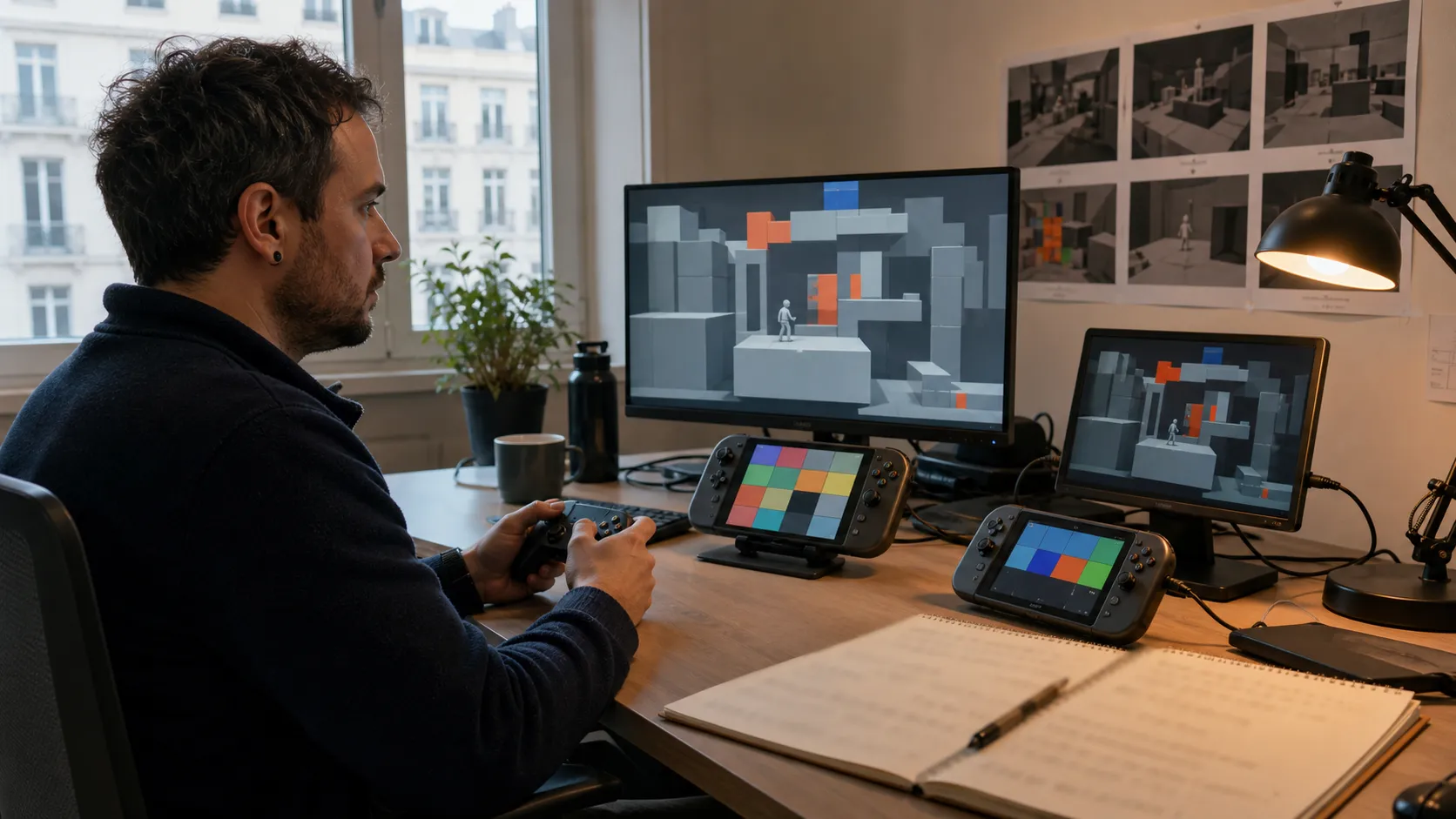


Illustrative editorial scenes. They show representative production moments, not Kioto Gaming staff, premises or client work.
The right model depends on how much is known, where the risk sits and how closely the work must evolve with your internal team.
For a technical discovery, mechanic prototype, benchmark asset or release assessment with a decision at the end.
Best when the unknown is more important than volume.For a feature or production stream that must evolve inside the same backlog, build and review cadence as your team.
Best when context and iteration are continuous.For a defined slice, platform adaptation or delivery package with agreed proof points and an explicit hand-off.
Best when the destination is clear enough to govern.Practical guides for evaluating external development work before it becomes a contract or a bottleneck.
Black Knife Catacombs: a developer-focused look at a compact Liurnia dungeon Tucked into the northern cliffs of Liurnia, just northeast of the Erdtree, the…
Jacinthe pokemon Legends Z-A: the Rank B promotion match explained The Jacinthe pokemon encounter in Pokémon Legends Z-A is the gate between Rank C…
Rowland Oakes map: what the parchment actually tells you The first time a player finds a scrap of parchment in a quest, the instinct…
Send the milestone, the current state and the constraint that worries you most. We will use that context to decide whether a discovery conversation is useful—and say so plainly if the scope is not a fit.