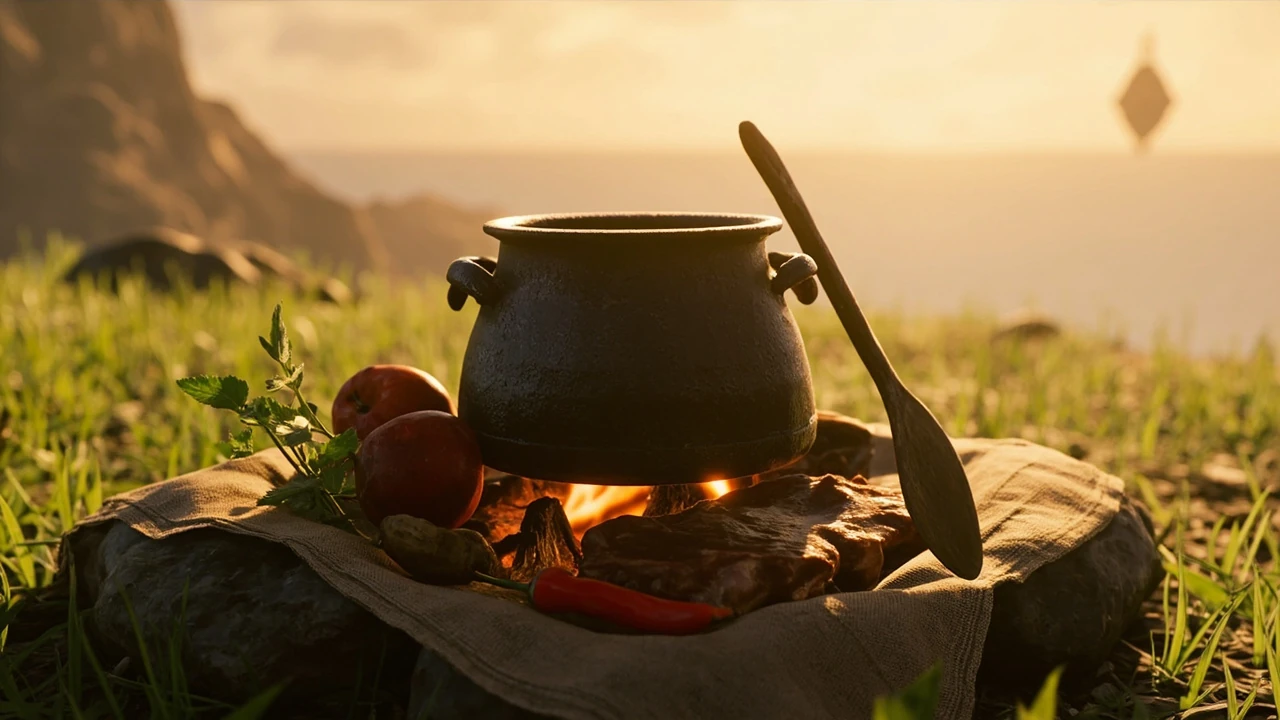
Breath of the Wild recipes: a developer-grade look at the cooking system
Cooking in The Legend of Zelda: Breath of the Wild is one of the most studied systems in modern action-adventure design because it does three jobs at once. It serves as a healing and buff loop, a discovery mechanic that rewards exploration, and a lightweight simulation that gives players real agency over how difficult a fight becomes. For developers, the cooking system is a case study in how a handful of simple rules can produce a very large set of meaningful breath of the wild recipes without overwhelming the player with menus or numbers.
This guide treats breath of the wild recipes as a system, not just a list. The first half walks through the rules the game actually uses to decide what a meal does, which ingredients matter, and how status effects interact. The second half turns that into a developer lens, looking at how the cooking system is structured, where the design pushes players, and what a small team can learn from it when designing crafting, buffs, or resource systems in their own projects.
How the cooking system actually works
At its core, the cooking system has three layers: ingredients with hidden stats, a small set of cooking rules, and a set of status effects that the system recognizes. The player only ever sees the output, a dish icon, a name, and a short description of hearts restored and any extra effect. Everything that produces that output is invisible, which is exactly the point.
Ingredients, hearts, and hidden values
Every cookable item in the game has a small set of hidden values that drive the result. These include a base heart recovery, a value that contributes to the strength of any bonus effect, and a category that determines what kind of dish the item belongs to when cooked.
- Meat and fish tend to provide the largest base heart recovery and lean toward hearty or meat-based dishes.
- Fruits and vegetables usually contribute smaller heart values but often carry useful status effects like cold resistance or attack up.
- Herbs, mushrooms, and spices are typically the effect carriers, raising attack, defense, speed, stealth, or resistance values when used.
- Monsters parts and certain critters add unique effects or, in the case of specific bugs and lizards, contribute to elixirs rather than meals.
These hidden values are why two seemingly similar ingredients produce different results. A raw meat and a bird drumstick look similar in the player’s inventory, but they contribute different heart values and categories. This separation between visual presentation and underlying data is one of the most interesting design choices, because it means that the “right” ingredient is not always the obvious one to a new player.
The five cooking rules the game applies
Despite the huge variety of possible breath of the wild recipes, the system only uses a handful of rules to determine the result. Internal analysis of the cooking logic, cross-referenced with the verified recipe index, points to five rules that consistently drive the output.
- All ingredients must be compatible with the same meal or elixir type. Meat and fish cook together; bugs and monsters parts cook together; mixing the two produces a “dubious food” result.
- The system sums the heart values of all valid ingredients, then rounds or caps the result to a sensible maximum.
- If any ingredient carries a status effect that matches another ingredient’s effect, the system upgrades the effect to its higher tier.
- Conflicting effects cancel each other out, which is one of the main causes of failed or low-value dishes.
- A small number of recipes are non-substitutable, meaning a specific ingredient combination is required to unlock a named dish and its unique bonus.
These five rules explain almost every surprise a player runs into while experimenting at a cooking pot. A player who throws a cold resistance fish and a heat resistance chili into the same pot will see a normal meal with no bonus effect, because the rules have cancelled the two opposing effects.
Status effects and how stacking works
Status effects in Breath of the Wild come in three tiers, often referred to as low, mid, and high, and they govern things like attack up, defense up, speed up, stealth up, and elemental resistance. A single ingredient with an effect tends to produce a low-tier bonus. Stacking two or more ingredients that share an effect bumps the dish to mid-tier, and stacking more or using a higher-value ingredient reaches the high tier. The maximum duration and strength is capped per dish, so the system rewards knowing which ingredients carry the most effect value per slot.
For developers, this is a clean example of additive design with a soft cap. The player is not given a slider or a numeric readout. Instead, the system translates ingredient choice into a single output and a small label like “Attack Up +” or “Cold Resistance”. The cost of complexity is hidden from the player but visible in the design data.
Mapping breath of the wild recipes by dish type
The verified recipe index organizes breath of the wild recipes by meal and dish type. Looking at those categories as a designer rather than a player exposes a clear structure: the game divides cooked output into three families, with a fourth fallback category for failed experiments.
| Dish family | Primary ingredients | Typical purpose | Example dishes |
|---|---|---|---|
| Meat and seafood dishes | Raw meats, poultry, fish, crabs | Bulk heart recovery, general combat prep | Meat Skewer, Seafood Skewer, Copious Meat Skewer |
| Fruit, vegetable, and mushroom dishes | Apples, herbs, mushrooms, peppers, pumpkins | Status effects, elemental resistance, exploration utility | Fruit Pie, Mushroom Skewer, Spicy Pepper Steak, Vegetable Curry |
| Elixirs | Bugs, frogs, lizards, monster parts | Specialized buffs, elemental resistance, stealth and speed boosts | Hasty Elixir, Sneaky Elixir, Tough Elixir, Fireproof Elixir |
| Dubious and Rock-Hard food | Conflicting or low-value ingredient mixes | Minimal recovery, no effect, sometimes a humorous result | Dubious Food, Rock-Hard Food |
The four families share a common rule set, but each has its own ingredient vocabulary. That separation is what allows the cooking system to feel deep without forcing the player to learn multiple rules. The mental model is: if I have a “food” item, I cook it with other food; if I have a “critter”, I cook it with monster parts.
Ingredient categories and what they actually contribute
Looking at the ingredient list as a data table is one of the most useful exercises for any developer working on crafting systems. Below is a simplified mapping of common ingredient groups to their dominant contribution in breath of the wild recipes.
| Ingredient group | Hearts contributed | Primary effect | Notes for design |
|---|---|---|---|
| Raw meats and poultry | Medium to high | None or attack up when paired | Best base for filling heart recovery |
| Fish and seafood | Medium | Speed up or cold resistance, depending on species | Some fish effects overlap, so stacking is not always additive |
| Apples, berries, and fruits | Low | Often none, or modest recovery when cooked in groups | Useful filler but rarely the star of a dish |
| Herbs and mushrooms | Low to medium | Attack up, defense up, elemental resistance | Carry the majority of named effects |
| Peppers and spicy plants | Low | Cold resistance, sometimes attack up | Regional in the game world, which encourages exploration |
| Bugs, frogs, lizards | Low when used alone | Stealth, speed, attack, defense, elemental resistance | Only useful inside elixirs; wasted in regular meals |
| Monster parts | None by themselves | Defines elixir tier and duration | Quality of the part influences how long the buff lasts |
The hidden values behind this table are exactly what a designer needs to think about. The player sees mushrooms as mushrooms; the system sees a stat block. The challenge is to expose just enough of that information through naming, visual flavor, and trial-and-error to let players make informed choices without ever opening a numeric menu.
How a developer would model the cooking system
If a small team wanted to recreate the feeling of breath of the wild recipes in their own action-adventure or survival title, the cleanest approach is to treat the cooking pot as a small rule engine rather than a recipe book. The recipes the player can discover are emergent outputs of a small set of rules, not a lookup table of fixed combinations.
Core data model
Where this page references specific ingredients, effects, or dish names, the source is the verified All Recipes and Cookbook, which provides useful background for this point. index. That page documents breath of the wild recipes by meal and dish type and notes that cooking is extensive while there is no in-game tracker for them. A few recipes in the index are marked as non-substitutable, which is a useful constraint to keep in mind when reading any “swap anything for anything” advice elsewhere on the web.
A minimum viable model has three structures: an ingredient definition, a status effect definition, and a cooking rule list. Each ingredient references zero or more status effects, along with a base heart value and a category tag such as food, elixir_critter, or monster_part. The status effect carries a tier, a duration curve, and a flag for whether it is elemental resistance, stat boost, or special.
A pseudocode skeleton of the cooking function would look like this:
function cook(items): if items contain both food and elixir_critter: return dubious_food base_hearts = sum(item.heart_value for item in items) effects = collect(item.effects for item in items) resolved = resolve_conflicts(effects) resolved = upgrade_tier(resolved) dish = find_matching_named_recipe(items) or generate_dish(resolved) return dish with base_hearts and resolved
The find_matching_named_recipe step is what handles non-substitutable breath of the wild recipes. If the combination matches a known dish, the system returns the canonical name and any unique bonus. Otherwise, the system uses the resolved effect list and ingredient family to generate a generic name like “Spicy Mushroom Skewer”.
Conflict resolution and tiering
Effect conflicts are easier to model than they look. Each effect has an effect group, such as “temperature resistance”. If two effects from the same group but opposite poles are present, the system cancels both. If they are in the same group with the same polarity, the system upgrades the tier. This pattern works for any “two sides of a spectrum” pair in a design, from temperature to moral alignment to faction loyalty.
Tiering is a separate concern. The system tracks the strongest single ingredient for each effect, sums the number of contributors, and maps that onto a low, mid, or high tier. A simple lookup table for each effect is usually enough, with separate curves for “duration” and “intensity” so the developer can tune one without breaking the other.
Cooking as a player-facing mechanic
From the player’s side, the cooking system is mostly about discovery. The game does not present a list of valid breath of the wild recipes. Instead, the player learns through trial, error, and pattern recognition. A dish that gives “Attack Up +++” after cooking a handful of hearty radishes is a stronger signal than any tooltip. The system also has no built-in recipe log, which the verified recipe index calls out directly. That absence is a deliberate design decision, and it has a few clear consequences.
What “no recipe log” actually changes
Without a persistent list, players develop their own mental list. That memory work is part of the engagement loop, and it is the reason cooking in Breath of the Wild feels like an acquired skill rather than a menu to navigate. For developers, the takeaway is not “remove the recipe log”, it is “consider what the recipe log costs the player in terms of agency and discovery”.
- A persistent recipe log reduces friction, but it also reduces the feeling of mastery that comes from internalizing a system.
- Without a log, players fall back on external tools like community wikis, which means the design effectively creates a third-party documentation layer.
- The absence of a log is a design choice, not a missing feature, and it pairs with the rest of the game’s low-UI philosophy.
For a small studio, the practical question is whether your own game’s crafting or buff system would lose something important by exposing a list. If the system’s fun comes from executing what you already know, a log is fine. If the fun comes from discovering it, the list is a spoiler.
Cooking in combat and exploration
One reason the cooking system holds up over a 60+ hour playthrough is that it is useful in every part of the game. Heart recovery is a constant need, but the system also supports specific challenges. Cold environments push players toward spicy dishes, hot deserts push them toward cooling dishes, and boss fights push them toward high-tier attack or defense meals. The cooking pot becomes a strategic tool, not just a heal button.
For developers, the lesson is that a crafting system benefits from being integrated with the world’s challenges. A healing system that only matters in boss fights is a niche tool. A cooking system that changes how a player approaches a snow biome, a thunderstorm, or a Lynel fight is a system that carries the whole game.
Common pitfalls when designing similar systems
Studying breath of the wild recipes is a useful shortcut for spotting mistakes in crafting and cooking systems of your own. A few pitfalls show up over and over in player feedback for similar mechanics in other games.
- Too many ingredient types without a clear way to distinguish them. Players end up picking whatever is in their inventory rather than making a meaningful choice.
- Effects that never cancel or interact, which turns the system into a one-dimensional stacking minigame.
- Hard-coded recipes with no flexibility, which removes the feeling that the player is the chef.
- No way to fail or partially succeed, which removes tension from the choice of what to cook.
- Exposing every variable on screen, which turns cooking into a spreadsheet exercise rather than an exploration tool.
Cooking in Breath of the Wild avoids each of these by keeping the visible surface area small, hiding the underlying data, and letting effects stack, cancel, and combine through a small rule set. That is a useful design pattern regardless of genre, from survival crafting to RPG buff systems to real-time strategy economy design.
Applying the design pattern in a small project
A small team with a six-month timeline can borrow the cooking system pattern without copying it. The goal is to capture the same feeling: real choices, emergent results, and a system that supports both combat and exploration.
- Pick two to four effect groups. Too many effect groups dilute the design. Temperature, combat, and stealth is a sensible trio for a survival action game.
- Define three to five ingredients per group, each with a tier and a small flavor description. The flavor is what teaches the player the rules.
- Keep the rule set to five or fewer rules. The Breath of the Wild cooking system is essentially five rules, and that is what makes it feel like a single coherent mechanic rather than a series of subsystems.
- Make at least a few named dishes that are non-substitutable. These serve as anchors for the player and create memorable recipes that the community will talk about.
- Test with players who have never seen the system. Watch where they fail, where they succeed, and which ingredients they remember without prompting.
Most of the magic in breath of the wild recipes is not in the cooking pot itself. It is in the loop of finding an ingredient, learning what it does through a failed or successful cook, and then using that knowledge to overcome an environmental challenge later. A small project that preserves that loop will feel closer to Breath of the Wild than a project that copies the recipes and nothing else.
Frequently asked questions
How many breath of the wild recipes are there in total?
The verified recipe index groups recipes by meal and dish type and covers every standard cookable combination in the base game. The exact count depends on how non-substitutable dishes are counted, because some entries are variants of the same core recipe with different ingredient tiers. For practical purposes, players who learn the underlying rules can produce several hundred distinct meals and elixirs, but the number of meaningfully different dishes is closer to a few dozen.
Are there recipes in Breath of the Wild that cannot be substituted?
Yes. The verified recipe index explicitly notes that some recipes do not include substitutions, which means certain dishes require a specific ingredient combination to unlock their name, art, and unique bonus. A player who swaps a key ingredient for something similar will get a generic dish instead, even if the underlying stat output is close.
Why does my dish come out as Dubious Food?
Dubious Food is the cooking system’s way of saying the ingredient mix failed. The most common causes are mixing a food item with a critter or monster part, or stacking ingredients whose effects cancel each other. A simple rule of thumb: cook food with food, and cook critters with monster parts. If the result is still dubious, the effects are likely conflicting.
Do buffs from cooking stack with armor or food bonuses?
Status effects from meals and elixirs operate on the same stat system as armor set bonuses, weather effects, and certain shrine blessings. Stacking a high-tier attack meal with an attack-up armor set usually pushes the bonus to its cap rather than adding without limit, which is why the system feels generous without ever becoming trivially overpowered. The exact cap depends on the stat and the source.
What is the fastest way to find new recipes while playing?
Talking to NPCs in stables and villages is the most reliable in-game method, because the verified recipe index points out that you can learn breath of the wild recipes from characters across Hyrule. Beyond that, picking up every new ingredient and cooking a small test meal is a low-cost way to learn the rules without losing many resources. Cooking near a high-value ingredient tends to surface interesting results quickly.
Is there an in-game recipe tracker or cookbook?
No. The verified recipe index calls this out directly: the cooking system is extensive, but there is no in-game system that tracks which breath of the wild recipes a player has discovered. Players typically rely on memory, screenshots, or community resources to keep track of their favorites. For developers, this absence is a meaningful design decision, not a missing feature.
Are recipes the same in Breath of the Wild and Tears of the Kingdom?
No. The two games share the core cooking rules and ingredient families, but the recipe list, named dishes, and some ingredients are different. The verified recipe index points readers who want the sequel’s set to a separate guide for Tears of the Kingdom. Treat the two games as related systems rather than identical ones, especially when planning cross-title features or a remaster.
What makes Breath of the Wild’s cooking system a useful design reference?
It is one of the cleanest examples of a small rule set producing a large, expressive output. Five cooking rules, a small ingredient vocabulary, and a tiered effect system combine to give the player a deep crafting system without a complex UI. For a developer working on any system that turns a handful of inputs into a buff, an item, or a status, that combination of minimal rules and meaningful variety is a reliable pattern to study and adapt.