Black Knife Catacombs: a developer-focused look at a compact Liurnia dungeon
Tucked into the northern cliffs of Liurnia, just northeast of the Erdtree, the Black Knife Catacombs is a small, optional dungeon in Elden Ring that punches above its size. For a developer audience, the dungeon is useful precisely because it is short: every encounter, hazard, and reward sits on top of one another, and the pacing decision is visible within a single play session. Studying it side by side with a walkthrough such as the IGN Black Knife Catacombs guide shows how FromSoftware compresses tutorial, combat, exploration, and reward into a space most studios would spread across a whole region.
This article treats the dungeon as a case study in level design, enemy placement, resource planning, and encounter scripting. It assumes the reader is a developer, designer, or technical artist who wants to extract reusable patterns rather than just clear the dungeon. Mechanics described here are based on the verified guide excerpt; where a detail is not confirmed by the source, the article states that explicitly and explains how a developer can still reason about it from the level geometry.
What the Black Knife Catacombs actually contains
The Black Knife Catacombs is a minor dungeon in the Liurnia region of Elden Ring. It is optional, it sits on the eastern side of a small canyon in northern Liurnia, and it leads to a single mini-boss encounter rather than a full demigod or shardbearer fight. For developers, the more important detail is the structure: an outdoor approach, a stairwell that doubles as the first combat space, two interior rooms with connected encounters, and a sealed boss door. The whole dungeon can be traversed in minutes by an experienced player, which is exactly the property that makes it worth studying for pacing.
The verified guide excerpt confirms several structural pieces that frame the rest of this analysis:
- An outdoor path on the eastern side of a canyon that leads to the entrance.
- A spectral, headless enemy with a flaming sword, named Lhutel the Headless, guards the entryway.
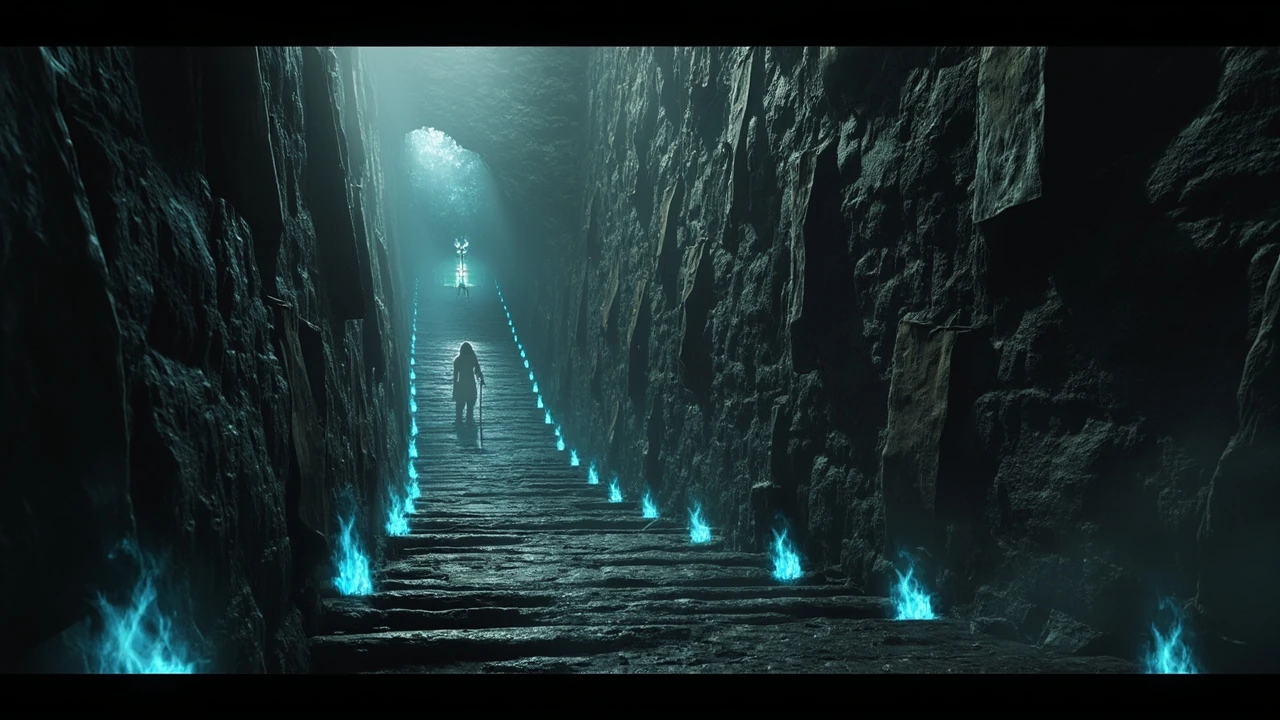
- Double doors in the cliff face open onto a stairwell down to a Site of Grace.
- The stairwell contains respawning skeleton enemies and a necromancer who must be killed to stop the resurrection loop.
- The interior rooms contain a Summoning Pool, an Imp Seal, plants for crafting upgrades, and a locked double door that leads to the dungeon boss.
For a developer, that is a complete vertical slice: outdoor tutorial, indoor combat puzzle, reward room, and boss gate. The same shape appears in many commercial dungeons and can be adapted to non-Elden Ring projects without copying any of the assets.
Dungeon metadata at a glance
The table below summarises the confirmed attributes of the Black Knife Catacombs. The intent is to give a designer or producer a quick reference they can use when comparing the dungeon to other Liurnia optional dungeons or to their own project’s rooms.
| Attribute | Value | Source |
|---|---|---|
| Region | Liurnia of the Lakes | Verified walkthrough |
| Type | Minor, optional dungeon | Verified walkthrough |
| Primary entrance context | Eastern path off a small canyon, north of the Erdtree | Verified walkthrough |
| Entry threat | Lhutel the Headless, spectral sword enemy | Verified walkthrough |
| First interior challenge | Respawning skeletons on a stairwell, countered by a necromancer | Verified walkthrough |
| Reward surfaces | Root Resin, Grave Glovewort (2), Grave Violet, Summoning Pool, Imp Seal | Verified walkthrough |
| Boss gating | Locked double doors at the bottom of the stairwell | Verified walkthrough |
| Estimated traversal | Short; minutes for an experienced player | Editorial inference from layout |
When comparing dungeons during a level design review, it is worth treating unverified attributes, such as the exact boss identity or treasure list, as “to be checked against current patch notes” rather than as fixed design constants. The layout itself is the part a developer can analyse reliably.
How the entrance space sets the contract with the player
The canyon approach is more than a way to place a Site of Grace. It is the first level-design contract. The player is on horseback at this stage of Elden Ring, and the guide notes that riding circles around Lhutel the Headless with Torrent makes the fight relatively easy. That single sentence is a clean demonstration of three design principles that translate well into other action RPGs and third-person combat games.
- Reward the player’s current tool. Torrent is the strongest movement tool the player has at this point, and the encounter geometry leaves room to use it.
- Make the “hard” path visible. A melee player can fight Lhutel head-on, but the open canyon shows them a lower-cost option without forcing it on them.
- Use the threat as a tutorial. A flaming sword and a spectral body telegraph the dungeon’s theme before the player reads any item description.
For a developer, the lesson is that the entrance fight is not filler. It is the player’s first opportunity to test their build against the dungeon’s core motif, and the level geometry should support a range of valid approaches rather than gating the player into a single solution.
The stairwell as a one-room combat puzzle
Once the player descends through the double doors, the dungeon compresses what could have been three rooms into one stairwell. Skeletons rise as the player approaches, and a necromancer at the bottom of the stairs keeps reviving them. The verified guide points out an important player behaviour: striking a skeleton once it has gone down only works if the necromancer has been dealt with first. The skeletons will not stay down while the caster is alive.
From a scripting perspective, that is a clean two-actor dependency graph. The designer can express it as follows:
- Skeleton actor: has a death state, a revive timer, and a check against the nearest necromancer before allowing the death to persist.
- Necromancer actor: exposes a status flag that downstream skeleton logic reads every time it would commit a revival.
- Room state: the room is “cleared” when all necromancers in it are dead, not when all skeletons are dead.
That pattern is engine-agnostic. In Unreal, it is straightforward to model with a Blackboard key on a Behaviour Tree; in Unity, a small ScriptableObject event channel and a list of caster references; in Godot, a signal from the caster to a room manager. The point is not which engine the developer uses, but that the encounter has a single, readable dependency that the player can discover through play.
Why the rule has to be discoverable, not told
The dungeon never tells the player to kill the necromancer first. Instead, the visual and audio design imply it. The necromancer is positioned further down the corridor, the skeletons cluster between the player and the caster, and the failed revive attempts only occur while the caster is alive. For a developer, this is the canonical “die a little to learn a lot” moment, and it is exactly the kind of compressed teaching moment that makes a short dungeon feel meaningful.
Reward placement as a pacing lever
Reward placement in the Black Knife Catacombs is a textbook example of how a small dungeon can still feel generous. The verified guide lists the following pickups and surfaces, all reachable in a single descent:
- Root Resin in the left-hand corner of the first interior room.
- A Grave Glovewort (2) plant at the top of the stairs on the left.
- A Grave Violet plant at the bottom of the same stair.
- A Summoning Pool near the locked doors.
- An Imp Seal on the left, which opens to a small side room with two more skeletons.
For a producer or level designer, the value here is that the rewards are not stacked. They are spread across vertical and horizontal space, which forces the player to move through the room rather than rushing the boss door. Each reward also has a different gameplay role: crafting upgrade, summoning co-op, and shortcut unlock via the Imp Seal. A player who clears the dungeon quickly still sees most of these, because the level geometry funnels them past the pickups in the natural path.
What the Imp Seal does, and what it does not do
Imp Seals in Elden Ring are a recurring mechanic that opens a hidden shortcut or a small side room. In the Black Knife Catacombs, the verified walkthrough describes the Imp Seal as leading to a small room with a swordsman skeleton in the centre and an archer in the immediate left-hand corner. That is a small encounter, but it has a clear design purpose.
| Side room element | Player decision it creates | Design intent |
|---|---|---|
| Archer in the corner | Approach from the doorway or close the gap first | Force a choice between ranged pressure and close-range burst |
| Swordsman in the centre | Engage the archer first or kite both | Reward a tactical pause over a frontal rush |
| Imp Seal itself | Open the seal or skip the room | Make the side content opt-in but spatially close |
The side room is also a test of the player’s awareness. The archer is positioned in the immediate left-hand corner, which punishes a player who runs in without checking line of sight. From a level scripting point of view, that is a one-line change: a NavMesh or AI awareness volume that triggers aggression when the player crosses a threshold. The impact, though, is much larger, because the encounter teaches the player to expect corner threats in similar rooms later in the game.
Boss gating and the locked double doors
At the bottom of the stairwell, the verified guide describes a pair of locked doors and a Summoning Pool. The lock is a deliberate pacing gate. Before the player can reach the boss arena, they have to clear the necromancer threat, defeat the skeletons, and decide whether to open the Imp Seal. The Summoning Pool is positioned right next to the door, which means a player who wants co-op help can co-opt it without backtracking.
For developers, three patterns are worth lifting directly:
- Place the co-op surface as close as possible to the boss gate. The cost of summoning is friction, and every metre of backtrack is a small but real loss of players.
- Use the locked door as a forced checkpoint. The player has to clear the room before they can move forward, which gives the encounter a clear start and end.
- Pair the gate with a small reward surface, such as a Summoning Pool or a bench, so that clearing the room feels valuable even before the boss is reached.
Enemy design notes that translate across games
The enemies in this dungeon are not unique to Elden Ring, and the same archetypes appear in many action RPGs. What is interesting is how the dungeon combines them into a single combat puzzle without overwhelming the player.
| Enemy | Role in the dungeon | Reusable lesson |
|---|---|---|
| Lhutel the Headless | Entrance sentinel with a thematic weapon | Use a signature visual and a signature weapon to encode the dungeon’s theme |
| Skeleton, respawning | Frontline pressure that reads as a solved problem once the caster is gone | Pair durable minions with a single caster so the player can “win” the room by reading the dependency |
| Necromancer | Hidden controller that forces a target switch | Hide the controller behind a chokepoint so the player has to push forward rather than kite |
| Skeleton swordsman | Mid-range threat in a side room | Use a side room to teach a related lesson at lower stakes |
| Skeleton archer | Corner threat that punishes reckless entries | Place a ranged enemy in a corner so line-of-sight checks become a habit |
Each of these archetypes is a one-component pattern. The dungeon works because the components are sequenced, not because any one of them is especially novel. That is a useful frame for small teams who have to ship a lot of content on a limited budget, and it ties directly into the kind of structured production budgeting covered in a producer-ready game development budget template.
How the dungeon fits into a larger production pipeline
Treating the Black Knife Catacombs as a production artefact, rather than just a piece of content, surfaces a number of pipeline considerations that recur across studios. The dungeon is small, but the asset list, the encounter scripting, and the QA surface are all proportional to a real shipping room.
- Modelling: the stairwell, the two interior rooms, the side room, the cliff-face entrance, and the canyon approach are all distinct meshes. A team that reuses a base set of catacomb tiles can keep this list short.
- Encounter scripting: at least three encounter blocks, each with their own logic for spawning, reviving, and clearing.
- Reward content: items, plants, a Summoning Pool, an Imp Seal, and the boss room itself all have to be integrated, localised, and balanced.
- QA: a short dungeon still needs a test pass for softlocks, the revive loop, the Imp Seal interaction, and the boss door trigger.
- Porting: the lighting, the spectral fire, and the resurrection visual effects all touch shader and rendering work, which is exactly the kind of detail covered in a porting checklist for cross-platform releases.
For a producer, the point is that even a “minor” dungeon is a real line item. The same budgeting logic that applies to a flagship dungeon applies here, just at a smaller scale.
What developers can learn about encounter pacing
Encounter pacing in the Black Knife Catacombs is unusually disciplined for a dungeon of its size. The player moves through five distinct beats in a single descent.
- Outdoor sentinel fight that sets the theme and rewards the player for using their mount.
- Stairwell descent that introduces a new enemy type and a hidden controller.
- Reward surfacing that turns the cleared stairwell into a place to breathe and pick up.
- Side room encounter that teaches a related lesson at lower stakes.
- Boss gate that turns the cleared room into a checkpoint and a co-op surface.
That sequence is a useful template for any developer designing a small dungeon or a single chapter of a larger game. The beats are: theme, teach, reward, branch, gate. Strip any of them away and the dungeon starts to feel either confusing or padded.
QA risks specific to this dungeon
Small dungeons concentrate their QA risk. The Black Knife Catacombs has at least four risk vectors that any QA lead would want to test on a representative build, not a development kit.
- Revive loop softlock: if the necromancer dies in a state that still allows skeletons to revive, the room can become impossible to clear.
- Imp Seal state: if the seal is opened but the skeletons inside are not spawned, the player can end up in an empty room with no reward surface.
- Boss door trigger: if the locked doors unlock on the wrong condition, the boss can become reachable before the room is cleared, which breaks the pacing gate.
- Summoning Pool placement: if the pool is too far from the boss door, co-op players end up backtracking, which can affect engagement metrics.
These risks are not unique to Elden Ring, and a project that is using the same room structure can apply the same checks. The wider point is that even an “optional” dungeon is part of the public-facing quality bar, which is why QA playbooks such as the prototype-to-release QA checklist treat minor dungeons as full test surfaces.
Art direction notes that are visible from play
The verified walkthrough does not give art direction, but the layout it describes is consistent with a deliberate art pipeline. The stone stairwell, the carved rock walls, the spectral blue fire on the weapons, and the warm lantern light in the first interior room are all visible signals. For a technical artist, three pipeline considerations follow from those signals.
- Lighting variety: the dungeon moves from a bright outdoor canyon, to a dim stairwell, to a warmer interior, to a sealed boss door. That is a deliberate four-stop lighting script that has to be authored, validated, and rebuilt on every platform.
- VFX on enemies: the spectral bodies and the flaming swords are GPU effects that have to be budgeted against the rest of the scene. A room with several of these effects is a real test of the shader and particle budget.
- Set dressing density: the planters, the banners, the Summoning Pool, and the Imp Seal are all separate props, each with their own LOD, collision, and lightmap contribution. A small room is often the densest per-square-metre set in the project.
For a team that is already thinking about an art outsourcing strategy, the Black Knife Catacombs is a useful reference for what a “minor” dungeon actually contains. The list above is the kind of work that an external vendor can deliver, but only if the brief is detailed enough, which is the core idea behind a structured art outsourcing pipeline.
Player-facing writing and item framing
The dungeon is small, but the items inside it are part of the player’s long-term build. Root Resin, Grave Glovewort, and Grave Violet are all upgrade materials that have to be described in the item database, localised, and balanced against other upgrade sources. For a writer or narrative designer, the lesson is that even a minor dungeon is a chance to reinforce the world’s tone.
- Item names should match the dungeon’s theme, so a catacomb in a land of assassins should not reward the player with a “mossy pebble”.
- Item descriptions should be short and concrete. Players read dozens of these in a sitting, and a wall of lore is more disruptive than informative.
- Localisation should account for plant and material names that do not translate literally, which is a content, not an engineering, decision.
Where developers should be cautious
It is worth being explicit about what this article can and cannot claim. The walkthrough excerpt supplied for verification is a single page from a third-party guide, and it is enough to confirm the layout, the entrance threat, the stairwell encounter, and the reward surfaces. It is not enough to confirm the exact boss, the boss’s moveset, the exact loot table, the current patch state, or any balance numbers. Any developer using this article as a reference should treat the structural claims as verified and the specifics as “check against current patch notes” or “playtest on a representative build”.
The same caution applies to design lessons. The patterns identified here are reusable, but they are not universal. A live-service game with daily resets will not gain much from a Summoning Pool next to the boss door, and a procedurally generated dungeon can lean harder on randomness and lighter on hand-placed rewards. The Black Knife Catacombs is best read as a handcrafted reference, not a template.
A short checklist for designing a dungeon like this
For a developer or designer who wants to design a comparable dungeon, the following checklist captures the structural choices verified in the Black Knife Catacombs and turns them into design tasks.
- Define the entrance contract. What tool does the player have, and how does the entrance fight reward that tool?
- Identify the hidden controller. Is there a single enemy or object that, when dealt with, changes the state of the room?
- Spread rewards across vertical and horizontal space, so the player has to move through the room rather than past it.
- Add a side room that teaches a related lesson at lower stakes, and gate it with a mechanic the player has already seen.
- Place the co-op surface as close to the boss gate as possible.
- Lock the boss door on a real condition, not on a flag that can desync.
- Test the room on a representative build, not a development kit, and budget the QA pass as a full line item.
How this article fits a wider production cluster
For readers who want to take the patterns here into their own production work, three adjacent articles on the same site cover the surrounding decisions in more depth. A developer designing a dungeon like the Black Knife Catacombs will quickly find themselves asking about budget, art pipeline, and QA, and those questions are exactly what the cluster is built for. A useful next step is to read the production-side companion pieces on budgeting and outsourcing before committing to a level design.
Frequently asked questions
Where is the Black Knife Catacombs in Elden Ring?
The Black Knife Catacombs is a minor, optional dungeon in the Liurnia region of Elden Ring. According to the verified walkthrough, the entrance is reached by taking a path on the eastern side of a small canyon in northern Liurnia, just northeast of the Erdtree. The approach is on foot or on horseback, and the area outside the dungeon is part of the open world rather than a separate loading zone.
Is the Black Knife Catacombs required to progress the main story?
No. The verified walkthrough describes it as an optional dungeon. It is home to a few treasure items and a mini-boss, and clearing it is not required to advance the main Elden Ring story. Players who want specific upgrade materials or a particular reward can prioritise it, but skipping it does not block the main quest.
What enemies are inside the Black Knife Catacombs?
The verified walkthrough confirms several enemy types. At the entrance, the player encounters Lhutel the Headless, a spectral headless enemy with a flaming sword. Inside, the player faces respawning skeletons on the stairwell, a necromancer enemy with a staff deeper in the corridor, and two more skeletons inside the room behind the Imp Seal: a swordsman in the centre and an archer in the immediate left-hand corner.
Why do the skeletons keep reviving in the dungeon?
The skeletons in the Black Knife Catacombs are kept alive by a necromancer enemy with a staff. The verified walkthrough explains that striking a skeleton to keep it down only works once the necromancer is defeated. Until then, the skeletons will resurrect and need to be defeated again. The intended counter is to push past the frontline and take out the caster first.
What rewards can be found in the Black Knife Catacombs?
The verified walkthrough lists several reward surfaces, all reachable inside the dungeon. They include Root Resin in the left-hand corner of the first interior room, a Grave Glovewort (2) plant at the top of the stairs on the left, a Grave Violet plant at the bottom of the same stair, a Summoning Pool near the locked doors, and an Imp Seal that opens onto a small side room with two additional skeletons.
What does the Imp Seal do in the Black Knife Catacombs?
Imp Seals in Elden Ring open hidden shortcuts or side rooms. In this dungeon, the Imp Seal is on the left of the interior space and opens onto a small room containing a swordsman skeleton in the centre and an archer in the immediate left-hand corner. It is an opt-in side encounter, but it is positioned so that a player who clears the main room will pass it on the natural path.
How long does it take to clear the Black Knife Catacombs?
The verified walkthrough describes a short dungeon, and the layout is consistent with a quick clear for an experienced player. The stairwell, the side room, and the boss gate are all in close proximity, and there is no extended traversal between encounters. New players who stop to read pickups or who are learning the revive-loop counter will take longer, but the dungeon is not designed as a long expedition.
What can game developers learn from the Black Knife Catacombs?
For developers, the most useful lessons are about pacing and dependency. The dungeon compresses a tutorial, a combat puzzle, a reward surface, a side encounter, and a boss gate into a single descent, which is a useful template for small dungeons and short chapters. The hidden-controller pattern, where a single enemy changes the state of the room, is also reusable across action RPGs, third-person combat games, and similar genres.
Does the Black Knife Catacombs have a boss?
The verified walkthrough describes a sealed boss area behind a locked double door, and the dungeon is described as home to a mini-boss Foe. The exact identity, moveset, and reward of the boss are not confirmed by the supplied source, and the current article treats those details as “check against current patch notes” rather than as fixed design constants.
Is the Black Knife Catacombs a good reference for a small indie dungeon?
It is a useful reference for any team designing a compact, handcrafted dungeon, because every encounter and reward is visible from the layout itself. The patterns are reusable, but a small team should adapt them to their own tools, art pipeline, and engine rather than copying the assets. The structural choices about reward placement, hidden controllers, and boss gating are the parts that translate cleanly across projects.