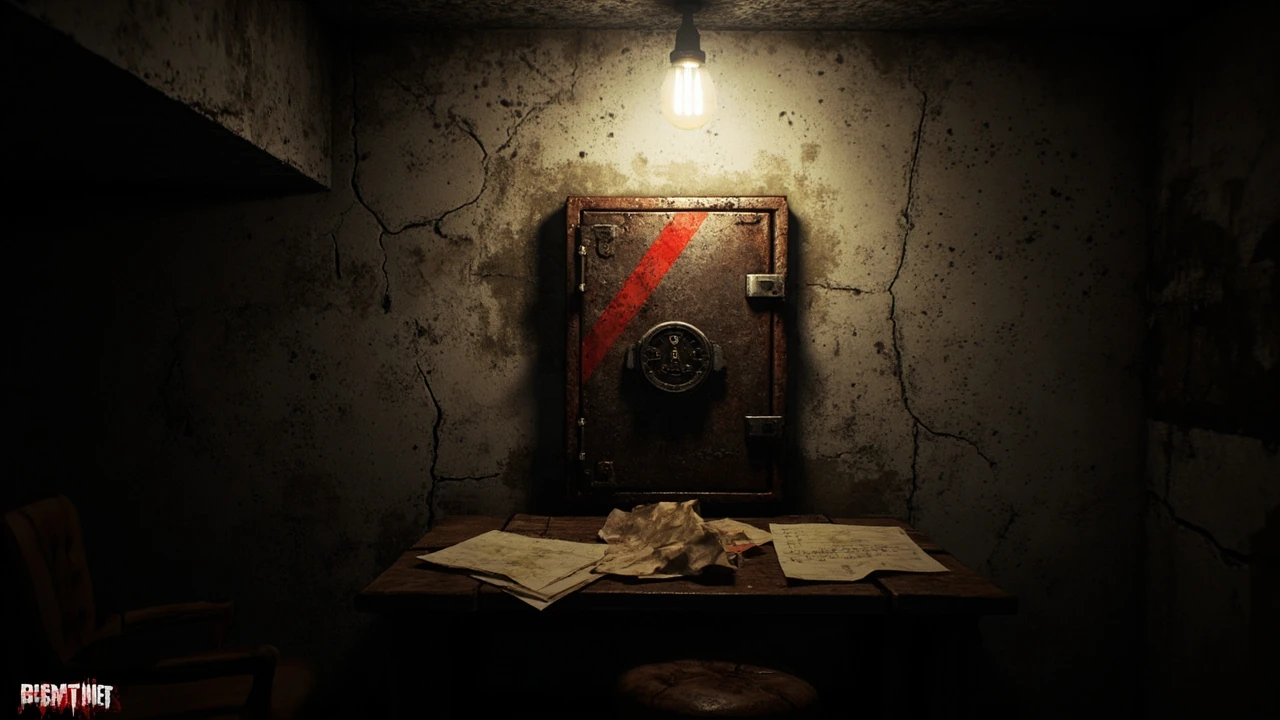
Searching for the resident evil 9 safe code is, in most cases, a player looking for the exact dial combination rather than an essay. That intent is real and important, and the player-facing answer belongs on a walkthrough site. The reason it also deserves attention on a GameDev publication is that a safe code in a survival horror game is never just a number. It is a small, embedded puzzle mechanic that has to teach the player how to read an environment, reward investigation, gate progression, and survive a testing pass without breaking flow. Treat the safe as a design object and the dial becomes a case study in how Capcom-style level design uses tiny systems to deliver dread, rhythm, and reward.
This article focuses on how a mechanic like the resident evil 9 safe code is built, tested, and balanced. It assumes the reader is a developer, technical designer, level designer, or producer who wants to understand the pattern well enough to use it, critique it, or defend a similar design decision in their own project. The player who only needs the four digits will not find a cheat sheet here. They will, however, find a clear explanation of why those digits are placed where they are, what alternatives the level team had, and what trade-offs determine whether a safe feels fair or feels like guesswork.
For broader context on the franchise, the long history of the Resident Evil series, and how the developer has historically handled progression gating, the Wikipedia entry on the series is a useful starting point. It documents how the franchise evolved from tank controls and fixed camera angles to modern third-person survival horror, and how small embedded puzzles like safes, locks, and key doors have remained a constant design tool. For a recent example of how Capcom has adapted a classic entry for new hardware, the announcement that Resident Evil 4 VR launched on October 21st on Oculus Quest 2 shows that even the smallest progression objects had to be reconsidered for a new interaction model.
Resident Evil 9 safe code: what the mechanic actually is
At the surface, the resident evil 9 safe code is a four-character combination that opens a lockable container somewhere in the game world. Mechanically, it is a small input system: the player manipulates a dial, the game reads an integer sequence, and a condition check decides whether the safe opens. The interesting part is everything around that input. The code has to be discovered, it has to be communicated to the player, it has to be checked against the player’s mental state, and it has to be balanced against the value of the reward inside the safe.
A safe in a survival horror game typically performs three jobs at once. It gates progression, it teaches the player to read the environment, and it delivers a reward that changes the player’s options. If any one of those jobs is poorly tuned, the safe becomes a friction point rather than a feature. Good implementations feel like a small victory against a hostile world. Bad implementations feel like an artificial roadblock the developer forgot to design for.
What players actually need to solve one
For a safe to feel fair, the player needs four things before they ever touch the dial. They need a reason to believe a safe exists in the current area. They need a way to discover the code itself, whether that is a document, a photograph, a voice cue, a stained wall, or a numerical pattern. They need a way to return to the safe without losing the code. And they need feedback that a wrong attempt is a wrong attempt, not a permanent failure. When the design supports all four, even a four-digit code can become a memorable moment.
When the design fails one of those four jobs, the safe becomes a search engine problem rather than a game problem. The player walks away, opens a browser, and looks for the resident evil 9 safe code. That is a useful signal to any developer: if your progression object is being solved outside the game, the design has not earned its place. The pattern below shows the minimum environment contract that a safe has to satisfy.
| Player need | Design responsibility | Failure mode when ignored |
|---|---|---|
| Awareness that a safe exists | Distinct silhouette, lighting, audio cue at proximity | Player skips the object entirely |
| Discoverable code | Document, photograph, environmental clue, NPC dialogue | Player brute-forces or exits the game to look it up |
| Persistent code memory | Code added to a notes UI, document kept in inventory | Player returns and forgets the digits |
| Failure feedback | Click, shake, red light, or a soft denial animation | Player assumes the safe is bugged |
How the code is delivered in modern survival horror design
The delivery of a code is where most design discussion happens because it is the difference between a puzzle and a chore. A safe code can be delivered as a literal written number, as a photograph of a specific object that implies a number, as a series of small environmental hints that combine into a sequence, or as a callback to an earlier piece of information the player already collected. Each delivery method has a different skill ceiling, a different accessibility profile, and a different replayability story.
Literal written numbers are the easiest to deliver and the easiest to test. They are also the easiest to bypass, because a player who finds the document can simply type the digits and move on. Photographic and environmental hints are richer because they ask the player to interpret an image, decode a date, read a clock, or count objects. They are also significantly harder to localize, harder to test for color-blind players, and harder to maintain when the level art changes during production.
Callbacks, where the code is built from information the player was handed much earlier, are the most elegant. They reward attentive players, they create a sense that the world is coherent, and they almost never produce search engine leakage because the answer is not sitting in a single readable document. They are also the most expensive to write, because every callback has to coexist with at least two plausible alternative interpretations, and the level designer has to verify that the callback is reachable on the player’s critical path.
Delivery methods compared
- Literal document: A note, diary, or memo that spells out the digits. Cheap to author, easy to test, but feels like a fetch quest and is the first thing search engines index.
- Photograph or image: A picture of a clock, a calendar, a receipt, or a license plate that encodes the digits. Higher engagement, but localization and color-blind support cost real budget.
- Environmental pattern: Counting candles, paintings, or scratches on a wall that add up to the sequence. Strong sense of place, but fragile under art iteration.
- Callback: The digits are taken from a number the player saw earlier, such as a door code, a phone number, a child’s age, or a date on a photograph. Highest reward, highest authoring cost, and easiest to misalign with the player’s collection order.
The dial as an input system
Once the code is known, the player still has to enter it. The dial itself is an input device, and it has to be designed like one. The number of characters, the rotation behavior, the visual feedback per step, and the audio feedback per step all have to support both a player who is paying close attention and a player who is in a low-light, low-attention state because the room is dark and something is hunting them.
Most survival horror safes use a 4-digit code because four characters is a small enough search space to feel solvable but a large enough search space to make brute force pointless without a hint. A 3-digit code produces 1,000 combinations and feels too easy once the player understands the dial. A 5-digit code produces 100,000 combinations and starts to feel like a math problem rather than a moment. The franchise has historically landed on 4 as the right cognitive load for a single safe in a single room.
Input behavior is the part that is often under-designed. A good dial gives a small tick or click per number, a distinct feedback when the final number is reached, and a clear negative feedback when the sequence is wrong. The dial should also reset cleanly on a wrong attempt, which means the player should be able to start again without learning a new input. The accessibility profile of the dial matters here. Players with motor impairments, players on controllers, and players in VR all need a way to enter the code that does not punish them for the input device.
| Input design choice | What it supports | What it risks |
|---|---|---|
| 4-digit code | Cognitive load matches a single room | Player may brute force if no hint is present |
| Audible click per digit | Players in dark rooms or with visual impairment | Audio clutter in scenes with multiple safes |
| Auto-reset on wrong attempt | Reduces frustration, supports experimentation | Can mask state bugs during QA |
| Final digit has a stronger cue | Player knows they have completed the entry | Cue becomes predictable and breaks immersion |
Reward design and progression gating
A safe is not interesting by itself. It is interesting because of what it gates. The reward has to be calibrated against the cost of solving the code, the player’s current loadout, and the surrounding difficulty curve. If the reward is too small, the safe feels like padding. If the reward is too large, the safe becomes a mandatory stop that players will route around immersion to find.
Most survival horror games use a small set of reward archetypes inside safes. A high-capacity magazine, a healing item that the player is short on, a weapon attachment that opens a new playstyle, a key item for an optional area, or a purely narrative document that builds the world. The mix between these archetypes defines the personality of the safe. A safe that always contains a key item teaches the player that the safe is mandatory. A safe that always contains a cosmetic document teaches the player that the safe is optional flavor. A safe that sometimes contains a healing item teaches the player that the safe is a calculated risk.
For the resident evil 9 safe code in particular, the question for a designer is which archetype fits the room it sits in. A safe in an early, low-resource area should not contain a top-tier weapon, because that would unbalance later encounters. A safe in a late, high-resource area should not contain a single bullet, because that would feel like an insult after a hard code. The reward has to match the room’s narrative weight.
Reward archetypes for survival horror safes
- Consumable: Healing, ammo, or a craftable component. Best in mid-game areas where the player is low on resources.
- Key item: A required token for an optional or mandatory door. Best in late-game areas where the player is already over-equipped.
- Weapon or attachment: A new tool or a modification that changes how the player approaches combat. Best in transitional areas that introduce a new enemy type.
- Narrative document: A note, photograph, or audio log that builds lore. Best in early areas and in areas the player revisits.
Level design responsibilities around the safe
A safe is a small object, but it sits inside a larger level design problem. The level designer has to decide where the safe is visible, where the code is visible, and the path the player takes between them. That path is the actual difficulty curve. If the code is in the same room as the safe, the puzzle is trivial and only serves as a gate. If the code is across the map, the puzzle becomes a navigation problem in addition to a decoding problem.
Capcom-style level design tends to keep the code and the safe within a short loop. The player finds the code, has to backtrack a short distance, and the backtrack usually exposes one or two optional encounters that the player now has the firepower to handle. The safe sits at the edge of a safe zone, so opening it is a tension release. The level designer has to verify that none of those optional encounters become mandatory to survive, otherwise the safe becomes a death trap for under-equipped players.
There is also a pacing responsibility. Safes are usually placed at the end of a tension curve, not at the beginning. The player fights through a room, reaches a quiet area, finds the safe, and gets a small reward that stabilizes them before the next threat. A safe placed in a high-traffic area will be ignored, and a safe placed before a high-traffic area will feel like a resource gate. Placement is the level designer’s primary lever for tuning the safe’s emotional weight.
Player psychology and the search engine problem
When a player leaves the game to search for the resident evil 9 safe code, that is a measurable signal. It tells the developer that the discovery loop failed. It does not mean the player is bad at the game. It means the design contract between the code, the document, the inventory, and the safe was not honored. The most common causes are documents that are too easy to miss, codes that are stored in a notes UI the player has not learned to check, and codes that depend on a non-obvious interpretation of a photograph.
Search engine leakage is also a feedback loop. Once a popular walkthrough site publishes the code, players who would have solved it legitimately are tempted to look it up because the lookup is faster than the backtrack. That is a design failure the developer cannot fully control, but it can be mitigated. A safe that requires the player to physically visit a specific room, look at a specific document, and combine two pieces of information is harder to bypass with a single search result than a safe whose code is printed in plain text on a single page.
For the developer, the right reaction to search engine leakage is to ask why the player preferred the search. The answer is usually one of three things: the discovery loop was too long, the discovery loop was too fragile under lighting or color-blind conditions, or the reward was not worth the cognitive cost. None of those problems are solved by hiding the code. They are solved by improving the contract between the safe, the code, and the room.
Testing and QA patterns for a safe code
A safe is one of the easier progression objects to test in isolation, but one of the harder objects to test in context. The QA team has to verify the dial input, the wrong-attempt feedback, the success feedback, the inventory update, the reward spawn, the save state, and the reload behavior. Each of those has its own failure mode, and the safe can pass every individual test while still failing the experience test.
Minimum QA checklist for a safe
- Discovery: A new player can find the safe on a clean playthrough without external hints.
- Code legibility: The document, photograph, or environmental clue is readable on the lowest supported display brightness and in the highest supported HDR calibration.
- Inventory persistence: The code is added to the notes UI and survives a save, quit, and reload cycle.
- Input edge cases: The dial accepts inputs from controller, keyboard, and any other supported input device with no loss of precision.
- Wrong attempt: A wrong code produces the expected denial feedback and resets the dial cleanly.
- Success path: A correct code opens the safe, plays the success animation, removes the safe from the interaction list, and adds the reward to the inventory.
- Reload safety: A save, quit, and reload with the safe open does not respawn the safe, respawn the reward, or break the document state.
- Localization: All numerical documents are localized correctly, including numerals, dates, and time formats.
Beyond the minimum checklist, the safe has to be tested in its room. The QA team should run a playthrough where the player never opens the safe and verify that the level is completable. They should run a playthrough where the player opens the safe and verify that the level is still completable. They should run a playthrough where the player opens the safe at the wrong time in the pacing curve and verify that the encounter balance still works. The safe is a small object with a long QA tail.
Accessibility considerations
A safe code is a small puzzle, but it sits on top of several accessibility contracts. Visual accessibility covers document legibility, dial readability, and HUD contrast. Motor accessibility covers dial rotation behavior on controller, keyboard, and any adaptive device. Cognitive accessibility covers the cognitive load of the decoding step and the persistence of the code in the notes UI. Auditory accessibility covers the audio feedback on each digit and the denial cue on a wrong attempt.
Visual accessibility is the most common failure point. A document that is readable on a desktop monitor can become unreadable on a handheld screen or in a low-contrast environment. A dial that is readable in a well-lit room can become unreadable in a dark room, which is a problem because survival horror is full of dark rooms. The mitigation is to make the document readable at the lowest supported display size and to make the dial readable in the lowest supported lighting condition. Both are testable and both are commonly missed in early passes.
Cognitive accessibility is the harder problem. A code that requires combining two pieces of information from two documents is a heavier cognitive load than a code printed on a single document. A pure callback is the heaviest. The mitigation is to keep the notes UI explicit. The player should be able to see the code, the document it came from, and any relevant context without leaving the notes UI. If the player has to remember a number across a combat encounter, the cognitive load is too high.
Common failure modes in safe design
For additional context, Most safe-related bugs and design complaints fall into a small set of categories. Recognizing the category is the fastest way to fix the problem during production and to debug it during post-launch support.
| Failure category | Typical cause | Detection method |
|---|---|---|
| Search engine leakage | Code is a single readable document | External analytics on the code as a search term |
| Wrong attempt loop | Dial does not reset on failure | QA playthrough with deliberate wrong input |
| Reward duplication | Safe respawns on reload | Save, quit, reload test |
| Discovery miss | Safe blends into environment | New player playthrough with no guidance |
| Document miss | Code document is in a low-traffic area | Heatmap analysis of document pickup |
| Localization break | Date or time format misread | Localization pass with native speakers |
How the resident evil 9 safe code fits the franchise’s progression history
The franchise has used safe codes as a progression tool since the original 1996 release, and the design has evolved with the engine and the input model. Early entries used fixed camera angles and tank controls, which made precise dial input harder but also made document pickup more readable because the camera framed the document explicitly. Modern third-person entries use a free camera, which makes dial input easier but also makes document pickup easier to miss because the player is steering the camera themselves.
The move to VR for the Resident Evil 4 remake required the team to reconsider every input method, including safe dials, and the Resident Evil 4 VR launch on Oculus Quest 2 is a useful case study. A dial that works on a controller does not automatically work in motion controls, and a document that works in a 2D HUD does not automatically work in a 3D space. The same pattern applies to the resident evil 9 safe code. Whatever input model the game ships with, the dial and the document have to be retuned for that model.
The franchise’s long history also tells a story about how the player’s tolerance for safe codes has changed. Early survival horror players expected dense puzzle loops and were willing to backtrack across a single mansion. Modern players expect faster feedback and shorter loops. A safe that requires a long backtrack in a 2026 release is more likely to push the player toward a walkthrough than it was in 1996. The design has to account for that shift, and the easiest way to account for it is to keep the code and the safe within a short loop and to make the discovery contract explicit.
Production workflow for a single safe
From a production perspective, a safe is a small but non-trivial task. It crosses level design, narrative, art, animation, audio, UI, and QA. The production team has to coordinate all of those streams, and the cost of that coordination is often larger than the cost of any individual asset.
- Level design: Places the safe, defines the code, and lays out the document location and the path between them.
- Narrative: Authors the document, defines the reward, and ensures the safe’s placement matches the room’s story beat.
- Art: Models the safe, lights the room, and ensures the safe’s silhouette is readable in the lighting condition the level designer requested.
- Animation: Produces the open animation, the dial tick animation, and the denial animation.
- Audio: Produces the dial tick sound, the success sound, and the denial sound.
- UI: Adds the code to the notes UI, links the document to the code, and ensures the notes UI is accessible on the lowest supported display size.
- QA: Runs the minimum checklist, the room-level playthrough, the reload test, and the localization test.
A safe that ships without any of those streams being coordinated will feel unfinished. A safe that ships with all of them coordinated will feel like a small, well-made object in a larger world. The difference is mostly production discipline.
How to use the safe pattern in your own project
The safe is a useful template for any small progression object in any genre, not just survival horror. A locked drawer, a ciphered terminal, a sealed door with a combination, or a security gate with a code all share the same design contract. The pattern scales down to a single document and a single input, and it scales up to a multi-stage puzzle that spans several rooms.
The minimum viable version of the pattern is a single document that contains a code, a single input object that accepts the code, and a single reward inside the object. The maximum viable version in a survival horror context is a callback that requires the player to remember a number from two rooms earlier, a dial with full audio feedback, a reward that opens a new playstyle, and a placement that closes a tension curve. Both versions are valid. The right version for a project is the one the team can ship without breaking the discovery contract.
For teams building their first safe, the right starting point is the minimum viable version. Get the discovery contract working first. Make the document readable, make the dial input reliable, make the reward meaningful, and make the failure feedback clear. Once that loop works, raise the cognitive load by turning the document into a photograph, a callback, or an environmental pattern. Each step up the cognitive ladder adds production cost, and the team should only pay that cost when the previous step is stable.
What to verify after launch
After a safe ships, the most useful post-launch signal is the search engine query. If a meaningful percentage of players are searching for the safe code, the discovery contract failed. The team should not interpret that as a player problem. The player behaved rationally. The design did not provide enough support for the player to solve the puzzle in-game. The mitigation is to look at the document’s pickup rate, the safe’s interaction rate, and the time between document pickup and safe interaction. A long gap between those two events is the strongest signal that the backtrack is the problem, not the decoding step.
The second most useful post-launch signal is the QA bug queue. Wrong-attempt loops, reward duplication, and reload safety are the three categories that most often survive into post-launch. A team that runs the minimum QA checklist for every safe in the project will catch most of those bugs before launch. A team that does not will spend the first month of post-launch support fixing safe bugs that should have been caught in certification.
For the resident evil 9 safe code specifically, the design choices that matter most are the discovery contract, the dial input behavior, and the reward calibration. If those three are right, the safe feels like a small victory. If any one of them is wrong, the safe becomes a search engine problem. The pattern is well understood, the tools are well established, and the cost of getting it right is mostly production discipline rather than technical invention.
Frequently asked questions
What is the resident evil 9 safe code?
The resident evil 9 safe code is the four-character combination that opens a lockable container in the game. As a player, the number itself is what you need to enter on the dial. As a developer, the more useful question is how the code is delivered, how the dial accepts input, and what the safe is gating. The article above treats the safe as a design object rather than as a cheat code, which is the most useful framing for a GameDev audience.
Why do survival horror games use 4-digit safe codes?
Four digits produce 10,000 possible combinations, which is a small enough search space to feel solvable but a large enough search space to make brute force pointless without a hint. Three digits feel too easy once the player understands the dial. Five digits start to feel like a math problem rather than a moment. Four is the cognitive load that matches a single room in a single playthrough, which is why the franchise has stayed close to it across multiple entries.
How do players usually find a safe code in survival horror?
The most common delivery is a written document such as a note, diary, or memo. The richest delivery is a callback, where the digits are taken from a number the player saw earlier, such as a date, a phone number, or a door code. A middle ground is a photograph or an environmental pattern, where the player has to interpret an image or count objects. Each delivery has a different skill ceiling, accessibility profile, and replayability story.
What makes a safe feel fair rather than frustrating?
A safe feels fair when the player knows it exists, has a way to discover the code, can keep the code in their notes, and gets clear feedback on a wrong attempt. When any one of those four conditions is missing, the safe starts to feel like guesswork. Search engine leakage is a reliable signal that at least one of those conditions failed, because a rational player will not leave the game to search for a number they could have found inside the game.
How should a safe be placed in a level?
The safe should sit at the end of a short tension curve, in a quiet area that the player reaches after a combat encounter or an exploration stretch. The code should be discoverable on the same loop, ideally in the same room or one room away. A long backtrack between the code and the safe increases the chance that the player forgets the number, exits the game, or routes around the puzzle. Placement is the level designer’s primary lever for tuning the safe’s emotional weight.
What should the safe contain?
The reward should match the room’s narrative weight and the player’s current loadout. A safe in an early, low-resource area should not contain a top-tier weapon, because that would unbalance later encounters. A safe in a late, high-resource area should not contain a single bullet, because that would feel like an insult after a hard code. A pure narrative document is best in early areas, a key item in late areas, and a consumable in transitional areas where the player is short on resources.
How do you test a safe during development?
The minimum QA checklist covers discovery, code legibility, inventory persistence, input edge cases, wrong attempt feedback, success path, reload safety, and localization. Beyond the minimum, the safe has to be tested in its room. The team should run a playthrough where the player never opens the safe, a playthrough where the player opens the safe, and a playthrough where the player opens the safe at the wrong time in the pacing curve. The safe is a small object with a long QA tail.
What are the most common post-launch bugs in safe design?
Wrong-attempt loops, where the dial does not reset on failure, are the most common. Reward duplication, where the safe respawns on reload, is the second most common. Discovery misses, where the safe blends into the environment, are the third. Localization breaks, where a date or time format is misread, are less common but more visible. A team that runs the minimum QA checklist for every safe will catch most of these before launch.
How does VR change safe design?
VR changes the input model, the document pickup model, and the notes UI. A dial that works on a controller does not automatically work in motion controls, and a document that works in a 2D HUD does not automatically work in a 3D space. The same applies to the safe in any new entry, including the one relevant here. Whatever input model the game ships with, the dial and the document have to be retuned for that model.
Can the safe pattern be used outside survival horror?
Yes. The pattern is useful for any small progression object in any genre, including locked drawers, ciphered terminals, sealed doors, and security gates. The minimum viable version is a single document, a single input object, and a single reward. The maximum viable version is a multi-stage callback with full audio feedback, a meaningful reward, and placement that closes a tension curve. Both versions are valid, and the right version for a project is the one the team can ship without breaking the discovery contract.