Epic universe as a game development case study
Epic universe is the working name most commonly used for Universal’s new Orlando theme park, but the phrase is also a useful lens for game teams. The five-land structure, the portal-based navigation, and the way each land is treated as a self-contained IP world all mirror decisions that game studios already make when they ship a flagship release and then live with it for years. Looking at the park the way a production lead would look at a game helps separate durable design lessons from pure marketing spectacle.
This article treats epic universe as a case study for game development, game production, and live operations. The focus is not on whether the park is a good vacation. It is on what game teams can learn from a real-world example of large-scale world building, IP licensing, attraction design, throughput engineering, and ongoing operations that have to keep running long after the opening day press cycle ends.
Why a theme park is a useful comparison for game teams
Theme parks and games share a surprising amount of production DNA. Both ship a fixed creative product, then operate it for years in front of a paying audience. Both depend on a small set of “headliner” experiences that justify the visit, surrounded by a wider set of secondary content that fills the day. Both have to balance narrative immersion with the practical reality of queues, rest, food, and accessibility. The same production language used in epic universe’s design studio therefore maps fairly cleanly onto a modern game studio’s vocabulary.
From a developer standpoint, the interesting questions are not about roller coasters. They are about scope management, content density, throughput engineering, the choice of a hub-and-spoke topology, and how to keep a built world feeling fresh after the novelty wears off. Those are the same problems a live-service game faces six to twelve months after launch.
The five-land structure mirrors a hub-and-spoke game
Epic universe is organized as a central hub, called Celestial Park, surrounded by five IP-based lands: Super Nintendo World, The Wizarding World of Harry Potter, Dark Universe, and Isle of Berk. Each land has its own entrances, its own narrative logic, its own food and merchandise, and its own headliner attractions. From a game designer’s perspective, this is a textbook hub-and-spoke map, the same topology seen in games from the original Super Mario 64 castle hub to modern open-world titles that use a central city as a navigation node.
The production trade-off is that hub-and-spoke maps are easy to read and easy to expand, but they tend to make repeat visits feel predictable once the spoke content is exhausted. The remedy, both in epic universe and in shipped games, is to layer live events, seasonal overlays, and small reasons to revisit the hub itself, not just the spokes.
| Theme park element | Game development equivalent | Production lesson |
|---|---|---|
| Central hub (Celestial Park) | Main menu city, open-world hub, social space | Hub needs its own content loop, not just navigation |
| IP-themed land (Super Nintendo World, Dark Universe) | Major DLC region, faction zone, biome | Each region needs a distinct gameplay or narrative hook |
| Headliner attraction | Main quest, raid, flagship dungeon | Two or three headliners justify the visit; more dilutes the brand |
| Portal entrance | Loading screen, transition cinematic, fast-travel point | Transitions are part of the design, not just plumbing |
| Seasonal overlays (holiday events) | Live ops seasons, battle passes, festivals | Seasonality requires its own content pipeline, not afterthought art |
Throughput engineering is the same problem as player capacity
Theme parks obsess over “throughput,” the number of guests an attraction can move per hour. Games obsess over a similar problem: how many concurrent players a server can hold, how many instances of a dungeon a backend can sustain, and how fast matchmaking can seat a new group. Epic universe’s design decisions around queue layout, single-rider lines, and Express Pass integration are essentially a physical-world version of dynamic instance scaling.
For a server engineer, the clean lesson is that a popular attraction in epic universe behaves like a popular raid in a live-service game. If you cannot scale the content, you have to scale the patience of the audience. The park’s choice to rely heavily on single-rider lines and timed entry is functionally identical to a game’s choice to use role-queue, cross-region matchmaking, or a token system to spread load.
For a designer, the lesson is that waiting is a design surface, not just an inconvenience. Epic universe invests heavily in the queue environment because the queue is part of the experience. Games have started to do the same in lobbies, dungeon intros, and PvP prep areas. The common mistake on both sides is to treat the wait as dead time that nobody will notice.
IP licensing and brand consistency
Epic universe is built on licensed IP, with Super Nintendo World, The Wizarding World of Harry Potter, and How to Train Your Dragon’s Isle of Berk as anchor lands. Each licensed land has to satisfy the brand owner, the operator, and the guest simultaneously. This is the same constraint a game studio faces when it builds within a publisher-owned franchise, when it licenses a sports league, or when it adapts a film.
The useful production rule is that licensed content is not free. Each license brings approval gates, marketing alignment, and a long review cycle for new content. A live event added in year three of a game often has to pass the same review as a ride overlay added in year three of a theme park. Teams that budget for that review cycle ship more live content; teams that do not end up with year three looking identical to year one.
| IP land in epic universe | Approval owner | Common production risk |
|---|---|---|
| Super Nintendo World | Nintendo and Universal Creative joint review | Character accuracy, new content must respect existing canon |
| The Wizarding World of Harry Potter | Warner Bros. and the Rowling estate | Tonal drift, new spells or items must fit the world rules |
| Dark Universe | Universal internal plus classic monster rights | Horror tone can over-restrict family-friendly cross-promotion |
| Isle of Berk | DreamWorks / Universal film IP | Continuity with current film projects and character arcs |
Art direction, palette, and player wayfinding
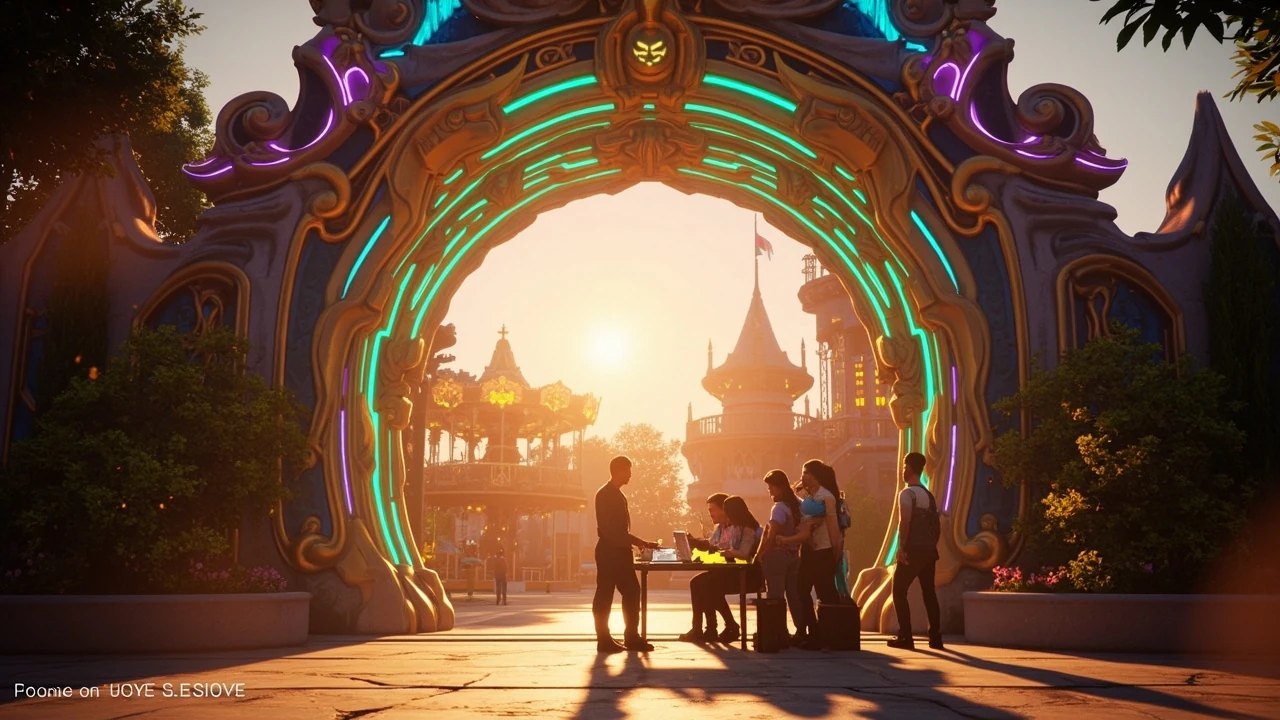
Visitors consistently comment on the turquoise, gold, royal blue, and purple palette of epic universe’s hub, and on how the portals create an obvious sense of direction. Game teams should pay attention to both. A unified hub palette helps a returning guest orient without a map; the same is true for a returning player in an MMO, a battle royale, or a live-ops shooter.
Wayfinding is one of the most under-discussed production topics in games. A poorly signed game wastes hours of a player’s session, exactly the way a poorly signed park wastes a guest’s day. Epic For additional context, universe uses color-coded portal frames, repeated motifs, and visual landmarks at the hub to support navigation. The equivalent in a game is consistent UI chrome, repeated map landmarks, and a visual identity that survives seasonal skins.
From an art production standpoint, the most reusable trick is to commit to a limited palette in the hub and let individual lands break the palette on purpose. When a player sees royal blue and gold, they know they are in the hub. When the palette shifts, they know they have crossed into a new region. The contrast itself does the work.
Live operations and the post-opening pipeline
Epic universe opened to the public in May 2025, and the production story does not end at the ribbon cutting. A new theme park has a multi-year content pipeline, with seasonal overlays, new shows, soft-attraction updates, and merchandise rotations. The day-one content is rarely the day-five-hundred content. A game shipped in 2026 that expects a 2027 player base has to plan for the same arc.
The production lesson is to staff the post-launch pipeline before launch, not after. The teams that handle year-two content need the same access to source files, the same level of tooling, and the same review relationships as the launch team. Otherwise the year-two content inevitably looks like a mod compared to the base game.
- Plan a dedicated post-launch art and content team, not a reassignment of launch staff.
- Keep source-of-truth assets, rigs, and shaders available to the live team with documentation.
- Treat seasonal content as a shipped product, with its own QA pass, not a last-minute skin drop.
- Maintain license approval channels that can move at the speed of live ops, not just the speed of a feature film.
Queue experience as a content surface
Epic universe invests heavily in the queue, treating it as a designed space with story elements, audio, and visual transitions rather than a plain line. Game developers can borrow the same idea for any “wait” state in a product: matchmaking queues, dungeon intros, raid assemblies, and login flows. The wait is always there, so the question is whether it is wasted or whether it sets up the next experience.
The risk, both in theme parks and in games, is over-investing in the queue and under-investing in the headline experience. A beautiful line that leads to a flat attraction is worse than a plain line that leads to a strong one. The epic universe design team appears to understand this, with headliner attractions carrying the bulk of the brand promise and queues supporting rather than substituting for them.
Accessibility, capacity, and inclusive design
Epic universe has to serve a wide age range, from small children to older visitors, including guests with mobility, sensory, and cognitive needs. The park uses single-rider lines, accessible viewing areas, sensory guides, and companion seating. Game teams face the same audience spread, often with the additional complexity of hardware variance and input devices.
The production lesson is that accessibility is a build-time decision, not a patch-time fix. Single-rider lines had to be designed into the physical layout; they cannot be glued onto a park after opening. Game-side equivalents, such as remappable controls, color-blind safe palettes, subtitle sizing, and motion-sensitive options, are easier to ship if the engine and UI framework were built with them in mind.
| Theme park accessibility feature | Game development equivalent | When to design it in |
|---|---|---|
| Single-rider line | Role queue, fast-match option | System design phase, before content ship |
| Sensory guide for attractions | Photosensitivity and motion warnings | Engine and settings menu, before certification |
| Companion seating on rides | Co-op assist, follower scaling | Combat and encounter design, before balance pass |
| Accessible viewing areas | Photo mode, spectator camera, replays | Camera system, before launch |
Onboarding first-time visitors without a tutorial pop-up
One reason epic universe works for first-time guests is that the park teaches its rules through the environment. The portals, the color palette, the layout of Celestial Park, and the placement of food and rest areas all act as a soft tutorial. Game studios often try to do the same thing, with mixed results, because the temptation to add an explicit tutorial overlay is strong when playtest data shows confusion.
The deeper lesson is that a well-designed space teaches faster than a pop-up. If a playtest shows that players do not understand a core mechanic, the first response should usually be to change the space, not to add a tutorial. Epic universe’s reliance on environmental storytelling is a strong example of teaching without breaking immersion, and a useful counterweight to the trend of stacking on-screen prompts.
Risk areas game teams should watch for
Looking at epic universe as a production case study is not all positive. There are real risks that game teams can map onto their own work, especially around opening-day pressure, throughput assumptions, and the cost of a confused first impression.
- Opening-day press and first-week crowds are not a representative workload. Plan for the slow Tuesday in month three, not the launch weekend.
- If the hub is weaker than the spokes, repeat visits will drop. Invest in the central content loop as heavily as the headliner attractions.
- Wait time anxiety can override every other design win. Throughput engineering deserves the same attention as art direction.
- License-heavy content can stall under review. Build a content calendar that accounts for approval lead time, not just production lead time.
- Seasonal overlays can feel hollow if they do not touch the core systems. Tie events to real progression, not just a new skin.
How this maps to a working game studio
A small to mid-size studio can take the epic universe model and apply it directly to a flagship release. The most useful exercise is to write down the equivalent of the five lands, the headliner attractions, the central hub, the queue experience, and the seasonal overlay pipeline for the game in development, and then check whether the production plan has dedicated owners for each.
What often falls out of that exercise is a gap. A team will have a clear plan for the headliner quests and a clear plan for the launch trailer, but no plan for the hub content loop in month nine, or for the seasonal event pipeline in year two. The gap is where most post-launch retention problems live, and it is exactly the gap that epic universe’s design process tried to close at park-scale.
Frequently asked questions
What does epic universe mean for game development?
Epic universe is useful as a real-world case study in world building, IP licensing, throughput engineering, and live operations. Game teams can map its five-land structure onto a hub-and-spoke game, its queue design onto matchmaking and prep areas, and its seasonal overlay pipeline onto a live ops content calendar.
Is epic universe an actual game or a theme park?
It is a theme park that opened in Orlando in May 2025. The phrase is used here as a production case study because the design decisions, especially around hub-and-spoke world building, IP management, and throughput, map onto decisions that game studios make for flagship releases and live service games.
How is the park organized from a design standpoint?
Epic universe is organized around a central hub called Celestial Park, connected by themed portals to five lands: Super Nintendo World, The Wizarding World of Harry Potter, Dark Universe, and Isle of Berk. Each land has its own narrative identity, headliner attractions, food, and merchandise, which functions like a major DLC region inside a larger persistent world.
What is the most useful production lesson for a small studio?
Plan a dedicated post-launch content team and pipeline before launch. Year-two content is what determines whether a release becomes a long-running live product, and it has to be staffed, tooled, and licensed for review at the same level as the launch team. Epic universe’s multi-year content pipeline is the clearest example of that principle at scale.
How does throughput engineering apply to games?
Throughput is the rate at which an experience can serve its audience. In epic universe that means guests per hour on a ride; in a game it means concurrent players per server, dungeon instances per minute, or matchmaking seat time. The design trick is to make waiting part of the experience, using queues, lobbies, and prep areas, instead of leaving them as dead time.
Why is IP licensing treated as a production topic?
Licensed content introduces approval gates and review cycles that can stall otherwise straightforward updates. In epic universe each IP land has its own approval chain, and the same is true for game studios building within a publisher-owned franchise, a sports license, or a film adaptation. Budgeting time and staff for review is part of the production cost, not a side effect of it.
Can a single-player game benefit from the epic universe model?
Yes, although the model maps more loosely. Hub-and-spoke design, environmental onboarding, and accessibility planning all apply to single-player releases. The lessons that do not apply directly are live ops throughput and seasonal content pipelines, which matter more for live-service and multiplayer titles.
What is the risk of focusing on the hub too much or too little?
A weak hub undermines repeat visits, because players have less reason to return once the spoke content is exhausted. A hub that is too strong relative to the spokes can compete with the headline content, pulling attention away from the experiences that justify the visit. The epic universe approach is to give Celestial Park its own content loop while keeping the spokes visibly distinct.
How do seasonal overlays map to game content?
Seasonal overlays in epic universe include holiday shows, themed food, and limited merchandise, which sit on top of the base park. In games this maps to battle passes, festivals, and limited events. The production rule in both cases is to treat seasonal content as a shipped product, with its own art pass, QA, and review, instead of a leftover task assigned after launch.
Where can a producer read more about the design of epic universe?
For a guest-side perspective, a first-timer’s breakdown of the park is useful as a reference for layout and pacing, and the same kind of first-visit write-up can help a producer stress-test their own wayfinding assumptions. Producer-side reading on similar problems is better sourced from game production literature on hub-and-spoke design, live ops pipelines, and license-driven development.