Prototype vs vertical slice
Compare purpose, fidelity, architecture and acceptance evidence for each early build.
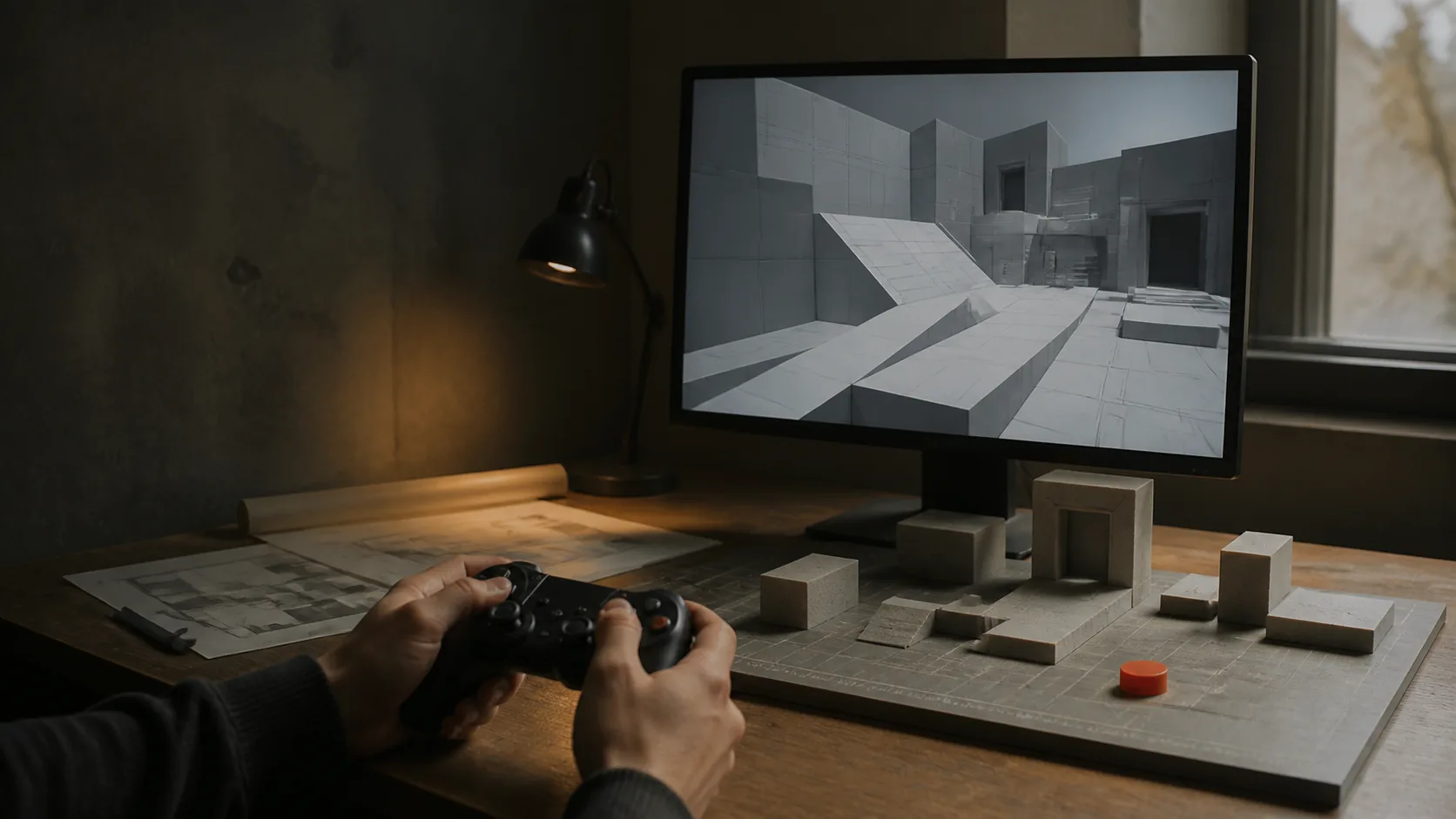
Playable proof in progressRepresentative editorial scene — not Kioto Gaming staff, premises or client work.
Playable proof and validation
Turn a design or technical hypothesis into a playable result that supports a real production decision.
Discuss this scopeProduction question / 01
A prototype should reduce uncertainty, not imitate a finished game. A vertical slice has a different job: it shows how representative gameplay, art, audio, UX, content and performance meet at a production-relevant quality bar. The scope starts by naming which decision the build must unlock.
See how the scope is builtA mechanic prototype can stay narrow and use temporary material when its purpose is to test control, readability or a core loop. A technical prototype can isolate networking, streaming, procedural generation, AI scale or another feasibility risk. Fidelity belongs only where it changes the validity of the test.
A vertical slice is a connected production sample. It needs representative systems and content, but it does not need every feature in the design. The useful slice includes repeated work and difficult dependencies so the team can estimate the wider production path from evidence rather than presentation quality alone.
Every build closes with a decision record. Playtest observations, performance conditions, open assumptions and implementation limits are kept with the source. A successful result can support the next phase. A failed hypothesis can still prevent a much larger and less informed commitment.
The build is shaped around the most consequential unknown, not a generic early-production checklist.
A focused playable loop tests input, feedback, rules, tuning range and repeated player decisions without paying for finish that does not affect the hypothesis.
A bounded experiment tests a technical assumption under relevant conditions. Build version, hardware, content load, failure states and limits are recorded with the result.
A representative sequence can combine gameplay, presentation and production evidence for a defined review audience. The scope states what the slice proves and what remains outside it.
The build is reviewed against explicit proof criteria. Findings are translated into a recommendation for another test, revised scope, production planning or a stop decision.
Prototype estimates become credible when the review decision, fidelity and treatment of the resulting work are explicit.
A founder, design team, publisher and technical lead may need different evidence from the same idea. The proposal names who reviews the build, the question they need answered and the observable conditions used in that review.
Every polished element should have a reason to exist. The scope distinguishes representative work from temporary material and identifies systems, content or routes that will not be inferred from the demonstration.
The plan states whether the implementation is disposable, a candidate for production or undecided until review. Source, test conditions, decisions and unresolved risks still need a hand-off even when the prototype itself will be replaced.
The useful output is the playable evidence and the decision it supports. A typical scope can include:
Time and fidelity are allocated only after the review decision is clear.
Step 01
We identify the audience, the uncertainty that matters and the choice the team should be able to make after review.
Step 02
Observable behaviours, target conditions and known exclusions stop stakeholders from expecting different things from the same build.
Step 03
Systems, content and fidelity are chosen because they affect the evidence. Temporary material is labelled so it does not become an accidental production commitment.
Step 04
Playtests, technical captures and stakeholder review use the same build and criteria. Conditions and limitations remain attached to the findings.
Step 05
The hand-off separates proven behaviour, reusable work, disposable code and remaining risk before a production plan or new experiment is approved.
A playable demo can create false confidence when its evidence and limits are not documented.
When feel, networking, art performance and production throughput are tested together, the team may not know which assumption caused the result. Separate proof work can be faster.
Presentation work is justified when it affects the review. Otherwise it can consume the budget while the core design or technical question remains unanswered.
A vertical slice can hide unbuilt tools, manual setup and unrepresentative content. The scope discloses which work can repeat and which parts were created only for the demonstration.
The strongest reason to build is a consequential decision that cannot be answered on paper.
These answers keep early builds connected to the decision they were funded to support.
A prototype tests a focused design or technical hypothesis. A vertical slice combines representative systems, content and presentation to test both the intended experience and a production approach. Polish alone does not define the difference.
There is no responsible duration before the proof question, existing technology, content needs and review conditions are known. A useful estimate names the build boundary, decision gates and what would cause another iteration.
Only after a deliberate review of ownership, data, tools, testability, performance and maintenance. Proven behaviour may be reusable even when the structure was intentionally optimized for learning speed.
It can support a pitch when it represents the intended experience and the claims made in the deck. The team should disclose the controlled route, temporary work and production risks that the slice does not resolve.
We will separate the required evidence from presentation work and map the smallest credible playable scope.