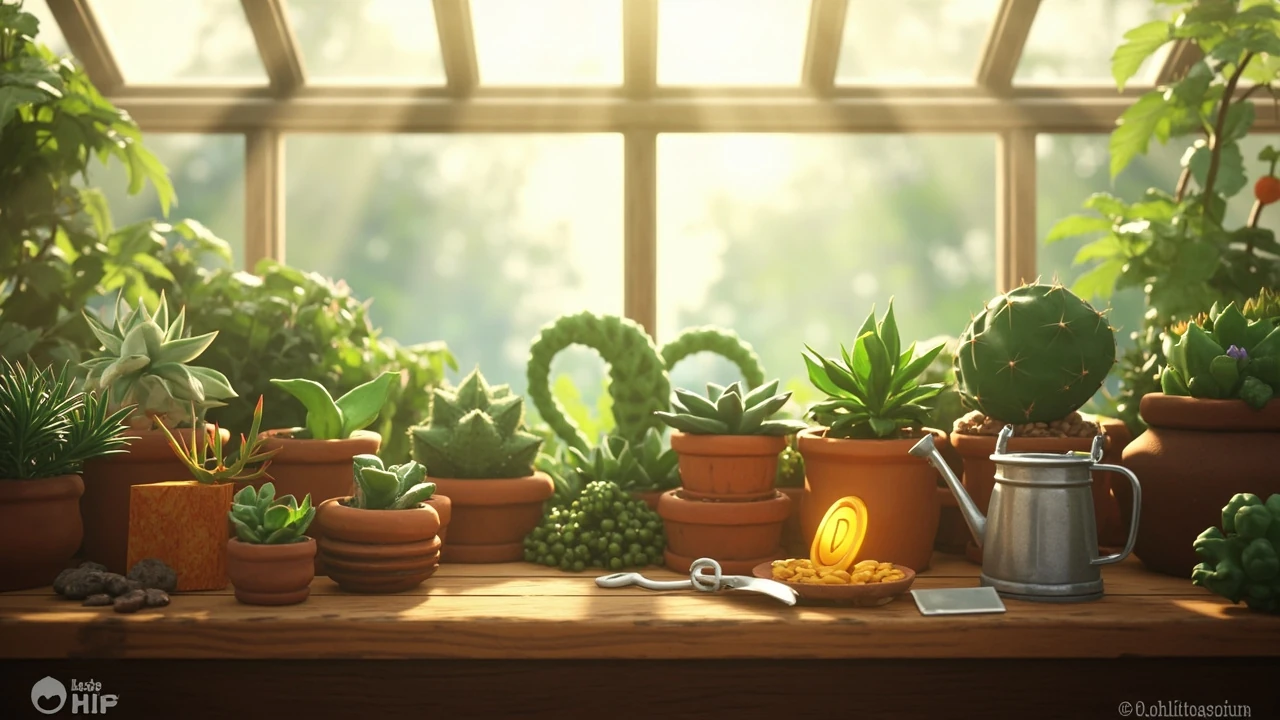
Prickly plants in Grow a Garden and how the system is designed
Grow a Garden is a Roblox farming sim built around a deceptively simple loop: plant a seed, wait for a growth timer, harvest a fruit, and sell it. Under that loop sits a layered economy in which some plants behave very differently from others. Prickly plants in Grow a Garden are one of those families that look like a cosmetic variant but actually change how a player should plan their plot, their inventory, and their spending.
These species cover the cacti and succulents that drop into the seed pool. They share a visual identity (spines, thick stems, low water demand) and a few mechanical traits that distinguish them from leafy crops and from flowering plants. The most useful way to read the family is as a single design pattern, then check each species against it. That is the same approach a developer would take when balancing a sub-class inside a larger progression system, and it is the lens this article uses throughout.
The guide below is written for players who want to understand the cactus family as a system, not just memorise a list. It also speaks to readers interested in the underlying design: how a Roblox title built by a small team can run a layered growth and mutation system, and what that reveals about economy balancing in live service games.
How the cactus family fits into the broader Grow a Garden economy
Grow a Garden divides its plants into broad families that share mechanics: leafy crops, fruits, flowers, and prickly species. Each family is tuned for a different moment in the progression curve. Leafy crops tend to be cheap, fast, and low value. Fruits and flowers sit in the middle, with longer timers and stronger payouts. Prickly plants are positioned as slow-growing, high-value species with mechanics that reward patience, mutation stacking, and careful inventory planning.
Two structural decisions shape that positioning. The first is the seed economy. Cactus seeds are not sold at the same flat rate as basic crops. They appear through specific shops, weather events, or targeted rewards, which means the supply side is intentionally constrained. The second is the harvest behaviour. Many prickly plants produce a small number of fruits per harvest, but each fruit carries a higher base value than a comparable leafy plant. That trade-off (lower volume, higher per-unit value) is a classic way to make a sub-class feel distinct without breaking the sell price curve.
For a player, the practical result is that a cactus bed is rarely a player’s first investment. It becomes attractive once a basic plot is already paying for itself and the player has spare coins, inventory space, and time to wait for the longer growth cycle. For a designer, the same result is a textbook example of using family-level constraints to gate a tier of content behind a progression milestone.
The prickly species in the current seed pool and the traits they share
The cactus family in Grow a Garden currently includes several species that share a recognizable silhouette: thick stems, spines, and a growth animation that pulls the plant upward rather than spreading outward. They differ in seed source, growth time, base value, and which mutations they tend to attract.
Across the family, four traits are consistent. First, growth timers are long compared with leafy crops, often several in-game days from seed to harvest. Second, each plant yields a small number of fruits per cycle, usually one to three, so a player’s income from a cactus bed is steady rather than spiky. Third, the base sell value of each fruit is meaningfully higher than that of a leafy crop of the same growth tier. Fourth, the family has a higher affinity for certain environmental mutations, particularly those linked to dry, hot, or sun-exposed conditions.
That shared behaviour matters because it lets a player plan the family as a unit. If you have one cactus bed, you can run the same watering, mutation, and harvest schedule across it. If you have three, you do not need to treat each species as a separate project. The same planning principle shows up in production: when a class of content shares the same scheduler, the same UI affordances, and the same failure modes, it is cheaper to develop and easier to balance.
| Species | Seed source | Approx. growth time | Base fruit value | Distinct mechanic |
|---|---|---|---|---|
| Cactus (basic) | Common seed shop rotation | Long | Moderate-high | Lowest watering need in the family |
| Desert spire | Event shop and weather rewards | Long | High | Higher affinity for sun and heat mutations |
| Barrel cactus | Rare seed drops and bundles | Very long | High | Wider harvest radius, fewer fruits per cycle |
| Prickly pear | Limited-time shop and crates | Long | High | Secondary fruit used in specific recipes |
| Saguaro-style cactus | End-of-season shop and milestones | Very long | Very high | Stackable height, affects visual layout of the plot |
Numbers in the table are illustrative ranges, not exact patch values. Grow a Garden updates its economy frequently, and the seed shop rotates. Treat the table as a shape of the family: the leftmost columns are easy, the rightmost columns are gated, and the value column rises with growth time. The same pattern is visible in any live service economy: as a content tier becomes rarer and slower, its per-unit payout has to grow enough to justify the wait, otherwise players abandon it.
The growth cycle, watering rules, and the patience trade-off
Every plant in Grow a Garden runs on a simple state machine: planted, growing, mature, harvested, and the empty tile waiting for the next seed. Cacti follow the same machine, but the timers are stretched and the watering rules are stricter. A cactus that dries out for too long does not die instantly, but it pauses growth and eventually returns to an earlier growth stage, which is functionally a soft penalty rather than a hard one.
That design choice is deliberate. A hard death penalty on a slow-growing plant would push players away from the family, because losing a multi-day growth cycle to a missed watering would feel punitive. A soft reset is kinder: the player loses time but keeps the plant. It is the same logic that drives save-anywhere systems in single-player games and respawn mechanics in cooperative titles. The cost of a mistake is real, but the cost is bounded.
For a player running a cactus bed, the practical advice is straightforward. Set a watering interval that matches the plant’s drought tolerance, not the player’s memory. If a cactus needs water every in-game day, schedule the check at the same real-world time each day. If a plot has multiple cacti, water them in a fixed order so that no tile is ever skipped. Most mistakes with the family are not bad luck; they are skipped routines.
Mutations, environmental triggers, and why cacti react to weather
Mutations are the system that turns a base cactus fruit into a higher-value variant. They are temporary or permanent buffs applied to a harvest and stack with the fruit’s base value. The base list of mutations includes size, weight, color shifts, and elemental affinities such as wet, dry, hot, cold, and wind. The cactus family has a stronger relationship with dry, hot, and sun-related mutations than with rain or cold ones, which mirrors how real desert plants respond to environmental change.
That environmental coupling is one of the more interesting design decisions in Grow a Garden, because it ties a plant’s value to a global state that the player can influence. Weather events are server-wide, which means every player on a server experiences the same dry spell or heatwave at the same time. A player who has planted a cactus bed before a hot weather event benefits twice: the cactus family has a high affinity for the relevant mutation, and the timing is shared across all players, which is a subtle nudge toward cooperative planning.
The development lesson here is that environmental mutations are doing two jobs at once. On the surface, they add variance to a harvest, which keeps the economy from feeling static. Underneath, they give the world a sense of being alive, because the same plant can produce different outcomes on different days without any change to the player’s actions. That is the same purpose weather serves in many larger games, from Minecraft rain to MMO regional events.
| Mutation type | Source | Cactus affinity | Effect on fruit |
|---|---|---|---|
| Sun-soaked | Hot weather event | High | Higher base value, golden tint |
| Dry-spell | Prolonged no-rain state | High | Modest value bump, slows spoilage |
| Wind-bent | Stormy weather | Low | Cosmetic visual, small value change |
| Rain-kissed | Rain event | Very low | Slight value penalty on cactus fruits |
| Twilight | Late-evening server time | Moderate | Color shift, value uplift, works across families |
| Golden | Rare server event | Moderate | Strong value multiplier, low drop chance |
The affinities above describe the design intent, not a fixed drop table. In practice, the cactus family is most reliable when paired with hot, dry, or twilight weather, and least reliable when paired with rain. A player who wants consistent cactus value should either plan plots for the right weather window or accept that off-window harvests will pay less.
Value, coin economy, and why a cactus bed pays off over weeks
A common mistake new players make is comparing the per-harvest value of a cactus with the per-harvest value of a leafy crop and concluding that leafy crops are better. That comparison is misleading because it ignores cycle time, plot count, and mutation variability. A cactus bed pays off across many cycles, not one.
To make the comparison fair, consider three numbers for each plant: growth time, expected yield per cycle, and expected value with a realistic mutation mix. A leafy crop with a short timer and a low base value, harvested often, can match a cactus’s gross income over a week. The cactus wins on time efficiency (a player does not need to return to the plot as often) and on mutation upside (a hot weather event can push a cactus harvest far above its base). The leafy crop wins on responsiveness (it pays for the next seed in minutes, not hours).
For most players, the optimal mix is a leafy base that funds daily play and a cactus layer that builds long-term coin. That is the same pattern a small studio uses when budgeting a live service: short-cycle content that funds the next sprint, long-cycle content that builds the next season. Reading the family in those terms makes the economy easier to reason about.
Inventory, plot planning, and the geometry of a cactus bed
Cacti behave differently from leafy crops in plot layout. They do not spread, so tiles do not compete for space in the same way, but their spines matter: a tile next to a mature cactus cannot host certain flower species because the spines are coded as a tile hazard. That is a small but real constraint when planning a mixed plot.
Three layout patterns work well for a cactus bed. The first is a dedicated cactus area, separated from the rest of the plot, so the spine hazard does not block other families. The second is a perimeter layout, where cacti ring the edge of the plot and the interior is reserved for leafy and flowering crops. The third is a single-row layout along a wall, useful for players with very small plots who still want at least one cactus in rotation.
From a production standpoint, the spine hazard is a clean way to enforce a layout decision without a hard rule. A developer can forbid mixed planting with a script, but a soft constraint that only affects certain species gives players the same outcome while leaving room for creative layouts. That kind of soft constraint is one of the cheapest tools in a level designer’s kit.
Events, weather, and where cactus seeds actually come from
Unlike basic seeds, which are always available in the standard shop, cactus seeds rotate through several sources. Some appear in the regular shop during specific days, some are sold only during weather events that favour the family, and some are locked behind milestone rewards or seasonal shops. That distribution is part of why a cactus bed is a deliberate choice rather than a default.
The implication for a player is that watching the shop and the weather forecast is part of the cactus strategy. A player who logs in during a hot weather event should expect dry-spell and sun-soaked mutations on existing cacti, and should also check whether the event shop has stocked a new cactus seed. A player who logs in during a cold rain event should expect low cactus yields and should spend that time on leafy crops that benefit from the same weather.
From a design perspective, this is a classic resource funnel. The game offers a higher-value family, but the seeds are gated by the same systems (weather, events, milestones) that already drive engagement. The funnel keeps the cactus family rare without requiring a hard paywall or a separate progression track.
Cross-family recipes and why prickly pear fruits are different
Most cactus fruits sell directly for coins, but a few, including prickly pear variants, are used in cross-family recipes that combine a cactus fruit with a leafy or floral ingredient. Those recipes are a small but stable part of the late-game economy, because the recipes themselves gate higher-value outputs. A player who has access to both a cactus bed and a flower bed can chase a recipe payout that neither bed could reach alone.
The cross-family use is also a useful signal for designers. If a plant family is only a sell commodity, it competes with every other sell commodity on price. If the same family feeds into a recipe, it occupies a niche that no other family can fill, and the designers can tune its drop rate and price independently. In Grow a Garden, the recipe niche is small, but it is the part of the cactus family that is least likely to be nerfed, because it is balanced against a recipe tree and not against the open market.
What the cactus family teaches a developer about sub-class design
For a reader who works in game development, the cactus family is a compact case study in sub-class design. It does five things at once, and each one is a pattern that recurs in larger titles.
- Family-level constraints: the cactus family shares a scheduler, a UI affordance, and a soft failure mode. That sharing is what makes the family cheap to develop and easy to teach to new players.
- Positioned gating: seeds enter through weather, events, and milestones. The gate is soft enough to be reachable, hard enough to feel like a milestone.
- Cycle-versus-value trade-off: long timers pay higher per-unit value. The trade-off is presented to the player, not hidden in tooltips.
- Environmental coupling: mutations link plant value to world state, which keeps the world feeling alive without adding new mechanics for the player to learn.
- Cross-family recipes: a small fraction of fruits feed into recipes, which protects the family from direct price comparisons with other sell-only commodities.
None of these patterns is exotic. Together, they form a recognizable structure: a slow, valuable, environmentally tied sub-class that is reachable through shared world events and protected from market pressure by a recipe niche. A developer can lift that structure almost verbatim into a different game by changing the visuals and the timers, and the balance would feel familiar to a player who has spent time in any farming or crafting economy.
Common mistakes players make with prickly plants
Most cactus-related mistakes fall into a small set of patterns. Recognizing them saves coins and time.
- Planting cacti too early: the family is gated by seed availability and rewards patience. Planting a single cactus on day one rarely beats a leafy rotation of the same value.
- Comparing per-harvest value only: a cactus looks weak next to a leafy crop on a single harvest. The right comparison is weekly income, including mutation upside.
- Ignoring weather windows: planting cacti during a long rain event and harvesting them before a hot event leaves the player with low-mutation fruits and a long wait.
- Mixing cacti with spines-sensitive flowers: a single mature cactus next to a flower bed can suppress part of the flower rotation, which is a quiet but real cost.
- Forgetting the watering routine: cacti are drought-tolerant, not drought-proof. Skipping the routine is the most common reason a slow plant resets to an earlier growth stage.
Each of these mistakes is a small over-rotation of the same bias: treating the cactus family as a cosmetically different leafy crop. It is a different family with a different rhythm, and the rhythm is the entire point.
Trade-offs the developers likely faced when balancing the family
Game designers rarely talk about their exact numbers, but the visible behaviour of the cactus family implies a small set of trade-offs. Naming them explicitly is useful for a reader who designs similar systems.
- Cycle length versus per-unit value: if the cycle is too long and the value too low, players skip the family. If the cycle is too short and the value too high, the family becomes the only family that matters. The current tuning sits in the slow-but-rewarding band.
- Seed scarcity versus player frustration: if seeds are too rare, players cannot experiment. If seeds are too common, the family loses its milestone feel. Event-gated seeds split the difference.
- Mutation strength versus predictability: if mutations are too strong, the best outcomes are gated by luck rather than planning. If they are too weak, the family feels flat. Hot-weather mutations on cacti sit in the middle: noticeable, but not dominant.
- Soft reset versus hard death: a hard death on a slow plant would push players away. A soft reset keeps the family friendly without removing all cost. This is the most likely reason cacti reset to an earlier stage rather than disappearing.
A reader who designs a similar sub-class can lift the same trade-off matrix. Each row is a slider, and the sliders interact. Pushing one slider too far forces a compensating move on another. The visible behaviour of the cactus family is a snapshot of those interactions being held in a stable position.
A practical routine for running a small cactus bed
Players who want a routine that works with limited time can use a simple loop. It is not a guide to instant riches, but it is a routine that holds up across updates.
- Reserve one row for cacti. A single row of cactus tiles, separated from leafy crops, gives the family a stable home and keeps the spine hazard away from flower beds.
- Plant during a dry or hot weather window. The first cycle of a cactus is the most exposed to low-mutation rolls. Planting during a hot window improves the average.
- Water on a fixed real-world schedule. A daily check at the same time is more reliable than a vague intention to water when convenient.
- Harvest and sell during weather events. If a hot or twilight event is running, harvest a day or two into it, not before, so the fruits have time to acquire a mutation.
- Use one cactus fruit per week for a recipe. Recipes protect a slice of cactus value from market pressure and keep the recipe tree useful.
- Reinvest a small share in seeds. A cactus bed that funds its own seed rotation is more stable than a bed that sells everything and buys seeds on impulse.
The routine is intentionally simple. The point is not to optimize the family; it is to keep a slow, valuable sub-class running without consuming the player’s full attention. That is the same principle a small studio applies when scheduling a long-cycle content drop: make it reliable, make it cheap to maintain, and let the value accumulate.
How this system relates to Roblox game development more broadly
Grow a Garden is a Roblox title, and that platform shapes the design choices in ways a non-Roblox reader might miss. Roblox games run in a shared client-server model, server-authoritative for state, with limited per-server memory and a high concurrency ceiling for players. The cactus family’s reliance on server-wide weather events is a direct fit: a single weather state per server is cheap to broadcast and easy to mutate. A per-player weather system would have been more interesting to design but far more expensive to run.
That trade-off is worth naming because it shows up in many Roblox economies. When the same mechanic is shared across a server, designers can use it as a coordination signal. When it is per-player, designers can use it as a personalization lever. Grow a Garden leans into the first mode, which is why weather, events, and milestones all feel like shared moments rather than solo content.
For a developer reading this as a Roblox case study, the lesson is to choose the server-wide axis early and route the rest of the design through it. The cactus family is what falls out of that choice: a sub-class that benefits from shared weather, a recipe tree that rewards players who participate in the same world, and a seed economy that uses event shops as a coordination layer. None of that is accidental, and none of it requires a large team to maintain.
What to watch in future updates to the cactus family
Live service games change, and a guide is only useful if it is honest about what can shift. The following are the levers most likely to move in future Grow a Garden updates, and the signals that would tell a player the lever has moved.
- Seed shop rotation: if a new cactus species enters the regular shop, expect its value to fall over the following weeks as supply normalises. Watch the shop page, not the patch notes.
- Mutation rebalancing: if hot or dry mutations lose their cactus affinity, the family becomes less weather-dependent and more seed-dependent. Watch the value curve, not the tooltips.
- Recipe tree changes: if a recipe drops a cactus ingredient, that ingredient loses its niche and becomes a pure sell commodity. Watch the recipe list before assuming a cactus species is still useful for non-coin outputs.
- Spine hazard changes: if the hazard is removed, the family becomes easier to mix with flowers, which weakens the layout decisions above. Watch the plot UI for the hazard indicator.
None of these predictions is a leak or a rumour. They are the levers that exist in the current system. A reader who watches the levers will spot a change earlier than a reader who only watches the patch notes, which is the right state of affairs in any live service economy.
Where this design pattern shows up in the wider genre
The cactus family in Grow a Garden is one instance of a pattern that recurs across farming, crafting, and life sim economies. A reader who recognises the pattern can transfer the reasoning to other games without re-learning the basics.
- Stardew Valley crops with multi-day growth timers share the cycle-versus-value trade-off, with a single-player twist: there is no server-wide weather, so the trade-off is purely per-player.
- Animal Crossing rare flowers use a similar gating pattern, with the gate being breeding and friend-code sharing rather than weather or events.
- Final Fantasy XIV gardening rare cross-breeds use a much steeper cycle-versus-value curve, with multi-real-day timers and very high per-unit value. The cactus family sits between the two extremes.
- Roblox simulator economies more broadly often pair a fast, cheap commodity with a slow, gated commodity, which is exactly the cactus-versus-leafy split in Grow a Garden.
Reading the cactus family against those comparisons makes its tuning clearer. It is not the slowest sub-class in the genre, it is not the most gated, and it is not the highest-value. It is a comfortable middle band that a small team can maintain and that a new player can reach without a steep learning curve. That combination is the entire reason the family is worth a guide of its own.
A short decision checklist before you plant a cactus
If you are weighing a new cactus bed, three questions are enough to decide. Do you have a stable leafy rotation that already funds your daily play? Do you have a row of tiles that can be dedicated to the family without blocking flowers? Can you commit to a daily watering check for the next several in-game days? A yes to all three means the family is a reasonable next step. A no to any of them means the family will cost more than it returns, and a leafy rotation is the better call for now.
The same three questions are the kind of decision a designer runs before adding a new sub-class to a live game. Do the prerequisites already exist? Is there room in the layout for the new content? Can the player maintain it without burning out? The cactus family in Grow a Garden was clearly designed against those questions, and a player who uses the same checklist will get a more honest read on whether the family fits their plot.
Frequently asked questions
What are prickly plants in Grow a Garden?
Prickly plants are the cactus and succulent family in Grow a Garden. They share a visual identity (spines, thick stems, low water demand) and a small set of mechanical traits, including long growth timers, low per-cycle yield, and a higher base fruit value than leafy crops of the same tier.
Which cactus species in Grow a Garden is best for coins?
There is no single best species. The species with the highest per-fruit base value are gated behind rarer seeds and longer growth timers, so they only outperform easier cacti if you can also stack the right mutations on them. For most players, the middle-tier species offer the best balance of availability, growth time, and value.
How often do prickly plants need to be watered?
Each cactus species has its own drought tolerance, but as a rule of thumb, a daily watering check during a hot or dry weather window is enough to keep the family healthy. Missing a day is rarely fatal, but a long gap can pause growth or reset the plant to an earlier stage.
What weather is best for prickly plants?
Hot, dry, and twilight weather windows are the most reliable for cactus harvests. Sun-soaked and dry-spell mutations have a high affinity for the family, while rain events tend to suppress cactus value. Plant during a hot window and harvest during the same window for the best average outcome.
Where do cactus seeds come from?
Cactus seeds rotate through several sources: the standard shop during specific days, weather-related event shops, milestone rewards, and seasonal bundles. The exact mix changes with each update, so checking the shop and the current event page is part of the cactus strategy.
Do cacti block nearby plants?
Mature cacti apply a soft hazard to adjacent tiles, which can interfere with certain flower species. A dedicated cactus row or a perimeter layout keeps the hazard contained and lets the rest of the plot run without interference.
Can cactus fruits be used in recipes?
Yes. A small number of cactus fruits, including some prickly pear variants, are used in cross-family recipes that combine a cactus fruit with a leafy or floral ingredient. Those recipes protect a slice of cactus value from market pressure and are the most stable part of the late-game cactus economy.
Is a cactus bed better than a leafy crop bed?
It depends on the time horizon. A leafy bed wins on responsiveness because it pays for the next seed in minutes. A cactus bed wins on time efficiency, mutation upside, and long-term value. The optimal setup for most players is a leafy base that funds daily play and a cactus layer that builds long-term coin.
How do events affect prickly plants?
Server-wide events such as hot spells, dry spells, twilight, and rare golden events all influence cactus value. Hot and dry events push cactus value up, twilight gives a small uplift, and rain events tend to push it down. The same events also stock event shops, which is where new cactus seeds often appear.
Will the cactus family change in future updates?
Almost certainly. Live service games rebalance sub-classes frequently, and the cactus family is visible enough to attract attention. Watch the seed shop rotation, the mutation list, the recipe tree, and the spine hazard indicator for early signals of a rebalance rather than relying on patch notes alone.